
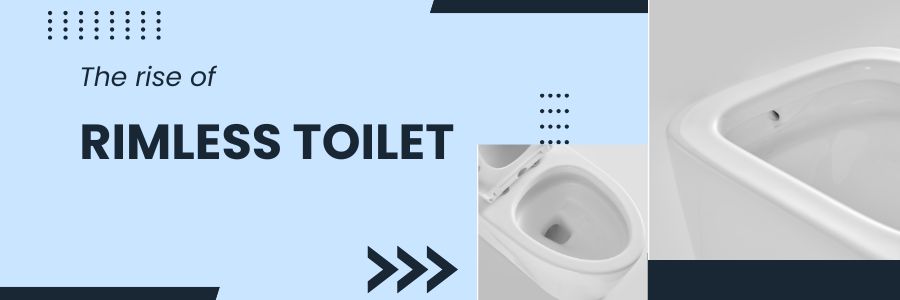
A few years ago, rimless toilets were a niche product — something you’d find in high-spec European bathrooms and not much else. Today, they’re one of the fastest-growing toilet categories globally, and buyers from Australia to the Middle East are starting to ask for them by name.
If you haven’t added rimless toilets to your product range yet, or if you’re not sure what makes them different from a sourcing and selling perspective, this guide is for you.
What Is a Rimless Toilet?
A traditional toilet bowl has a rim — a hollow channel that runs around the inside top edge of the bowl. When you flush, water flows through holes in this rim and cascades down the sides of the bowl to clear waste.
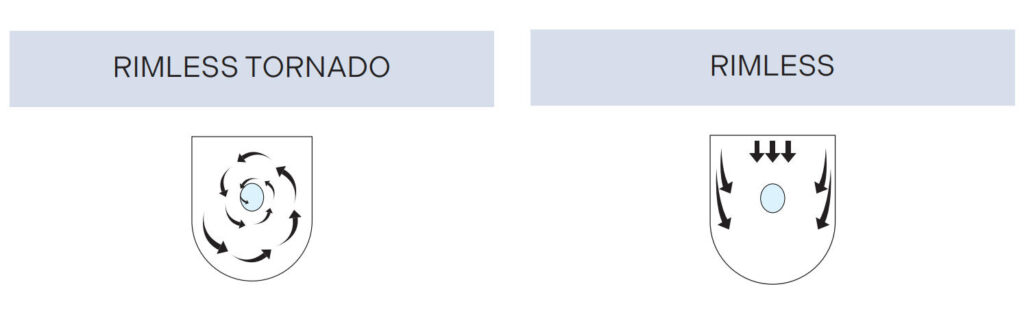
A rimless toilet removes that rim completely. Instead, the water is directed by a specially shaped ceramic channel — either a single-direction flow or a 360-degree swirl — that sends water across the entire bowl surface in one powerful, even sweep.
The result: the water covers more of the bowl surface, the flush is more effective, and — most importantly — there’s no hidden rim cavity where bacteria, limescale, and waste residue can build up out of sight.

Why the Market Is Moving Toward Rimless?
This isn’t a design trend for its own sake. There are real, practical reasons why rimless toilets have taken over the European market and are growing fast everywhere else.
Hygiene is the main driver. The traditional toilet rim is one of the hardest places to clean in any bathroom. The underside of the rim has hidden surfaces that a toilet brush can barely reach — and that’s where bacteria colonize. Studies cited by European hygiene standards bodies have shown that the underside of a traditional rim can harbor significantly higher bacterial counts than visible bowl surfaces.
Rimless toilets eliminate that problem entirely. The bowl is fully open and smooth — every surface is visible and reachable with a brush.
Commercial buyers understand this instinctively. Hotels, hospitals, care homes, and schools all deal with high-frequency toilet use and strict cleaning standards. Once a facilities manager understands the hygiene argument for rimless, it’s a very easy specification decision.
How the Flush Works: Directional vs. Tornado/Swirl
Not all rimless toilets flush the same way. There are two main approaches, and it’s worth understanding the difference when you’re evaluating factory samples.
Directional flush (also called direct flush or open-rim flush):
Water enters from one or two points and is directed across the bowl in a sweeping motion. This is a simpler ceramic design and is common in entry-to-mid level rimless toilets. It works well but may not cover the entire bowl surface with equal force.
Tornado / cyclone / swirl flush:
Water enters from two or more angled jets and creates a swirling vortex that covers the full bowl surface. This design is more effective at clearing the bowl and leaves less residue. It’s also more complex to manufacture — the internal water channel geometry is more precise. You’ll see this marketed under various brand names: Tornado Flush (TOTO), AquaBlade (Ideal Standard), and various OEM equivalents from Chinese factories.
For more toilet flushing systerms information, please read our toilet purchase guides.
What to ask your factory:
Request a flush demonstration video for the specific model — not a general promotional clip. A good rimless toilet should show water covering the full bowl surface in a single flush with no dry spots.
Rimless vs. Traditional Rim: Key Differences
| Rimless | Traditional Rim | |
|---|---|---|
| Hygiene | High — no hidden rim cavity | Lower — rim harbors bacteria |
| Cleaning effort | Easy — fully open bowl | Harder — rim underside hard to reach |
| Flush coverage | Full bowl surface | Depends on rim hole design |
| Manufacturing complexity | Higher | Standard |
| Factory price | 10–20% higher (same quality tier) | Standard baseline |
| Market perception | Modern, premium hygiene | Conventional |
| Dominant markets | Europe, Australia, growing globally | North America, South/South East Asia |
| Certification notes | EN 997 in Europe covers rimless | Standard certifications apply |
Where Rimless Is Already the Standard
🇪🇺 Europe Rimless is mainstream across Western Europe — especially Germany, the Netherlands, Belgium, and Scandinavia. In the UK, rimless has moved from premium to mid-market in the last five years. Many European bathroom retailers now stock more rimless SKUs than traditional rim toilets. If you’re selling into Europe and you don’t have a rimless option, you’re missing a significant part of the market.
🇦🇺 Australia & New Zealand Rimless is well established in the premium and mid-market segment. WELS certification still applies — and both rimless and traditional designs can carry WELS ratings. The hygiene argument resonates well with Australian buyers.
🌏 Middle East Hotel and luxury residential projects in the UAE and Saudi Arabia are increasingly specifying rimless. The hygiene positioning is very effective in this market. Volume residential is still traditional rim.
🇺🇸 United States & Canada Rimless is not yet mainstream in North America. Most American buyers and plumbers are unfamiliar with the concept, and the traditional toilet design is deeply entrenched. That said, the rimless category is beginning to appear in premium renovation and boutique hotel projects. It’s a market to watch, not a market to lead with right now.
🌏 Southeast Asia Growing in Singapore, Malaysia, and Thailand — mainly in hotel and premium condo projects. Standard residential construction still uses traditional designs.
So the market picture is clear — rimless is gaining ground across the regions that matter most for sourcing. But knowing where demand is growing is only half the story. The more important question for you as a buyer is: what does this actually mean for your business?
Why Rimless Is a Smart Business Move for Buyers
Adding rimless toilets to your range isn’t just about following a trend. There are concrete commercial reasons why it makes sense — and they go beyond simply stocking what buyers are asking for.
Higher retail margins on the same cost base
Rimless toilets are perceived as a functional upgrade, which means the market accepts a higher price tag. A rimless bowl from the same factory, at a 10–20% higher FOB cost, can realistically command a 25–40% premium at the retail or project level. That gap — between what you pay more and what you charge more — is where your margin improvement sits. For distributors and wholesalers, this is one of the clearest examples of a product upgrade that benefits both sides of the transaction.
Fewer after-sales headaches
Hygiene complaints are one of the most common sources of buyer dissatisfaction in the sanitary ware category. “The toilet is hard to clean,” “there’s always residue under the rim,” “housekeeping can’t get it properly clean” — these are the kinds of complaints that damage relationships with hotel buyers and property managers. Rimless bowls remove the problem at the source. The open bowl design leaves nothing to hide behind, which means fewer complaints landing back on your desk after delivery.
A direct route into high-value project segments
Hotels, hospitals, aged care facilities, and green-certified residential projects are actively looking for rimless products — not because they’ve seen it in a catalogue, but because their hygiene standards and certification requirements point them toward it. If you can supply rimless toilets with the right certifications (EN 997, WELS, WRAS), you’re already qualified to bid for projects that your competitors without a rimless range simply can’t access. Think of it as a product specification that doubles as a market access tool.
A clear point of differentiation for your brand
If you’re building a product catalog or a private label range, rimless gives you a visible, easy-to-explain feature that sets you apart from suppliers still leading with traditional rim products. It’s a feature that photographs well, that showroom visitors notice immediately, and that gives your sales team a compelling story to tell. In a category where many products look similar from the outside, “fully rimless, fully hygienic” is a positioning statement that lands.
The bottom line: rimless toilets cost a little more to source, but they open up better margins, better clients, and a better brand story. For buyers who are serious about growing their sanitary ware business beyond commodity volume, this is one of the most practical upgrades available right now.
With that commercial case in mind, let’s look at what actually separates a well-made rimless toilet from a poor one — because in this category, the quality gap between factories is wider than you might expect.
Sourcing Rimless Toilets from China: What to Look For
China’s sanitary ware factories — particularly in Foshan and Chaozhou — have been producing rimless toilets for European export for over a decade. Quality has improved significantly, but there’s still a wide range between factories. Here’s what I look for.
1. Ceramic quality and internal channel precision
The internal water channel that directs the flush must be precisely shaped and smoothly glazed. If the channel geometry is off — even slightly — the flush will have uneven coverage or weak spots. Ask to see a flush test on the actual production model, not a display sample.
2. Full-glaze coverage inside the bowl
The entire inner surface of a rimless bowl — including the under-curve at the front — should be uniformly glazed. Any unglazed or rough patches will collect residue and defeat the hygiene purpose of the rimless design. This is a basic quality check, but it’s easy to miss if you’re reviewing photos rather than physical samples.
3. Nano or antibacterial glaze
Many factories offer a nano-glaze or antibacterial glaze finish as an upgrade. This creates a micro-smooth surface that resists staining and makes cleaning even easier. For markets where hygiene is the main selling point — hospitals, hotels, care facilities — this upgrade is worth specifying. It typically adds USD $5–15 to the FOB price per unit.
4. Flush performance test data
Ask for the MAP (Maximum Performance) score or equivalent flush test results. A good rimless toilet should score 500g minimum for residential use; 1,000g or above for commercial or hotel use. Don’t accept verbal assurances — ask for the actual test report.

5. Certifications for your target market
For Europe: EN 997 covers toilet pans including rimless designs. For Australia/NZ: WELS applies. For the UK: WRAS. Rimless toilets don’t require different certifications from traditional designs — but the specific model must be certified, not just the brand or factory.
Selling Rimless to Your Buyers
The buyers who respond best to rimless toilets are those who are responsible for cleaning and maintenance — not just the person who specifies the product. Here are the arguments that work best:
For hotel buyers and facilities managers: “The underside of a traditional toilet rim is the hardest place in a bathroom to clean — and one of the highest-risk areas for bacterial buildup. A rimless bowl eliminates that surface entirely. Housekeeping staff can clean the full bowl in less time, with less product, and with better results.”
For residential developers: “Rimless is increasingly what design-conscious buyers expect — especially in European markets. It’s a feature that photographs well, that buyers notice on a showroom tour, and that adds perceived value without a major cost increase.”
For healthcare and aged care buyers: “Infection control is a formal requirement in healthcare environments. Rimless toilets reduce one of the primary bacterial harboring points in a washroom. They’re increasingly specified in NHS guidance in the UK and in similar standards in other markets.”
Conclusion
Rimless toilets are one of the clearest examples of a product category where the market is moving in one direction — and where getting in early gives you an advantage over buyers who wait.
If you’re ready to explore rimless toilet sourcing — whether for a specific project or to build out your product catalog — get in touch here. Tell me your target market and volume, and I’ll connect you with factories that have the right product and the right certifications.
FAQ’s for Rimless Toilet
1. What is the main advantage of a rimless toilet?
No hidden rim cavity means no place for bacteria and limescale to hide. The bowl is fully visible, fully reachable, and faster to clean. This is especially valuable in commercial and healthcare settings.
2. What are the disadvantages of a rimless toilet?
Slightly higher cost than traditional rim toilets. Flush coverage depends entirely on the quality of the internal ceramic channel — a poorly made rimless toilet can actually flush less effectively than a good traditional design. Quality matters more with rimless.
3. Are rimless toilets harder to manufacture?
Yes. The internal water channel must be precisely shaped and smoothly glazed. This requires more accurate molds and more careful production than a traditional rim design. It’s one reason why quality varies more between factories for rimless products.
4. Do rimless toilets splash more?
This is a common concern — and a fair one. Some poorly designed rimless toilets do create more splash than traditional designs, because the water hits the open bowl surface more directly. A well-designed swirl or tornado flush minimizes this by directing water along the bowl walls rather than into the center. Always request a flush test before finalizing your order.
5. Are rimless toilets available in wall-hung and floor-mounted versions?
Yes. Rimless is a bowl design feature, not a mounting type. You can source rimless toilets in floor-mounted, wall-hung, one-piece, and two-piece configurations. The combination of wall-hung + rimless is currently the most popular specification for hotel and premium residential projects in Europe.
6. Is rimless the same as “open rim” or “hurricane flush”?
These are different names for similar concepts used by different manufacturers. “Open rim” and “rimless” both refer to the removal of the traditional hollow rim. “Hurricane flush,” “tornado flush,” and “cyclone flush” refer to specific swirl-type flush mechanisms that are often — but not always — used in rimless designs.
7. Should I stock rimless if my main market is North America?
Not as a primary product, not yet. Rimless is still unfamiliar to most North American buyers and plumbers. If you have European, Australian or Singapore buyers, absolutely. If your market is purely North American for now, I’d prioritize other product differences first and revisit rimless in a couple of years as awareness grows.