Sintered stone keeps coming up more and more in conversations with buyers these days. Whether it’s for countertops, wall cladding, or furniture panels, people want to know what this material actually is, and why it’s getting so much attention lately.
I want to walk you through both of those questions in this guide. We’ll cover what sintered stone is made of, why it’s become such a popular choice, how it compares to other materials, and what to know before you start sourcing it.
What Is Sintered Stone Made Of?
Sintered stone is an engineered stone slab made by compressing natural minerals and firing them at extremely high temperatures. Unlike natural stone, it’s fully man-made, which means more consistent quality and larger slab sizes are possible.
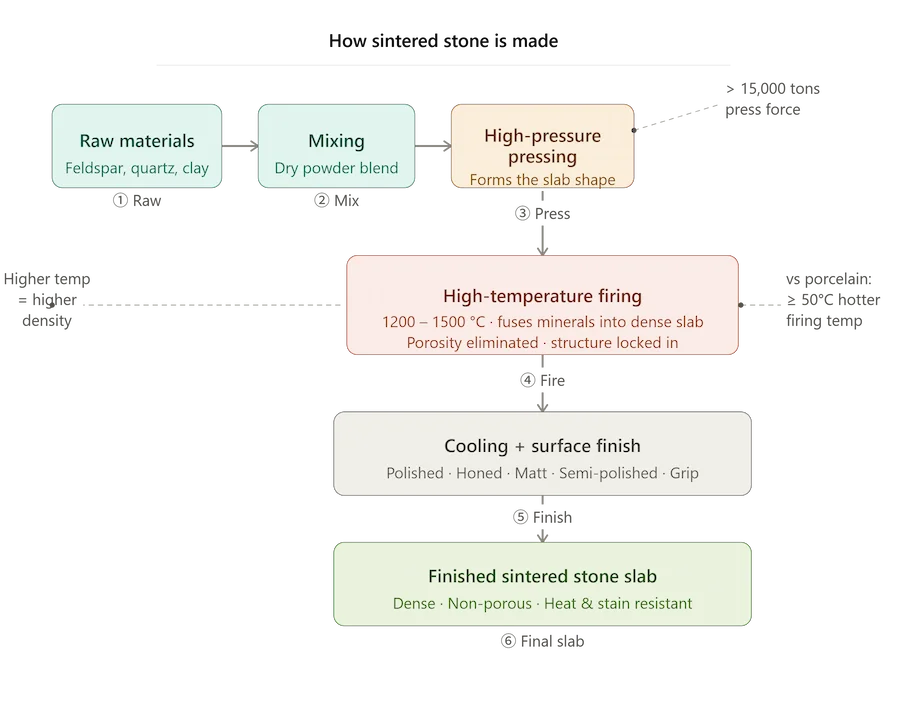
So what is it actually made of? The main raw materials are natural mineral powders, things like feldspar, quartz, and clay. These powders are carefully mixed, then pressed under very high pressure to form a slab shape. After that, the slab goes through a firing process at temperatures usually between 1200°C and 1500°C.
This is the part that really matters for buyers. The high temperature and high pressure fuse the mineral particles together very tightly. This creates a dense slab with very little empty space inside, known as low porosity. That density is directly connected to almost everything buyers care about, like how well the slab resists water, stains, and cracking. In short, the production process isn’t just a technical detail. It’s the reason sintered stone performs the way it does.
One more thing worth knowing here. In different markets, this same material sometimes goes by other names. In parts of Europe and North America, you may see it called an “ultra-compact surface,” or even “porcelain slab” in casual conversation. These names all point to the same general category of product, even though the exact formulas can vary slightly between brands. If you’re talking to the suppliers overseas, it helps to know they might be using a different word for the same thing you’re sourcing.
Why Is Sintered Stone So Popular Right Now?
This material didn’t become popular overnight. European brands were among the first to bring this category to market over a decade ago, originally positioning it as a stronger, more heat-resistant upgrade to quartz. In recent years, factories in China have built up serious production capacity, which has made sourcing sintered stone faster, more accessible, and more affordable for buyers around the world. That combination, strong brand awareness built in Europe, plus growing supply out of China, is a big part of why this material keeps showing up in more projects.
But there’s more to the story than just supply. A few real advantages are driving this demand.
Big Slabs, High-End Looks
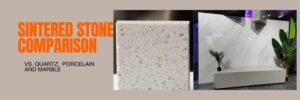
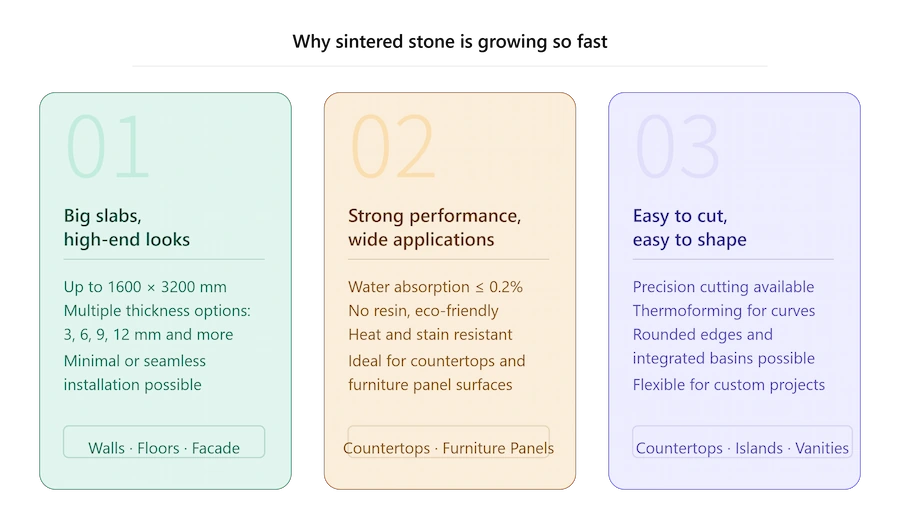
Large slab sizes mean fewer seams on a wall or floor, which gives a clean, high-end appearance. When it comes to marble-look designs, sintered stone can achieve that same premium feel, sometimes at a lower cost and with much easier maintenance than the real thing. If you want to see how sintered stone actually stacks up against natural marble, along with quartz and porcelain, I compared all four in detail here: Sintered Stone vs Quartz vs Porcelain vs Marble.
Strong Performance, From Kitchens to Outdoor Walls
Sintered stone has a very low water absorption rate, strong stain resistance, good wear resistance, and solid performance against freeze-thaw cycles. It’s also considered an eco-friendly material in terms of production. Because of these properties, it’s no longer limited to indoor walls and floors. It’s now widely used for outdoor walls, protective wall panels in high-traffic or high-hygiene environments, and furniture panels, where resistance to moisture and bacteria really matters. This shift toward furniture and panel applications has grown fast over the last two to three years, and I go into more detail on where different thicknesses and sizes fit best in this article: Sintered Stone Slabs: Sizes and Applications.
Easy to Cut, Easy to Shape
Sintered stone can be cut with precision, and it also supports thermoforming, meaning it can be heated and shaped into curves. This opens the door to countertops with rounded edges, integrated basins, and vanity tops, all made from a single continuous slab. This combination, looks great, performs well, and can be shaped into real products, is really what’s tying all these advantages together and pushing demand higher.
Multiple industry reports also point to steady growth for this material over the next several years, with most projecting solid year-over-year expansion as adoption spreads into more countries and more product categories.
Want to see our sintered stone designs? Visit this product page: https://www.tilesandbathroom.com/sintered-stone-slabs/.
Sintered Stone vs Quartz, Porcelain, and Marble: A Quick Look
In short, sintered stone tends to outperform quartz in heat resistance, since quartz contains resin that can be damaged by high heat. Compared to porcelain, sintered stone is fired at a higher temperature, giving it a denser structure and better strength. Compared to marble, sintered stone offers similar design flexibility across walls, floors, and countertops, but with far less maintenance, since marble is porous and prone to staining.
Here’s a quick side-by-side look at how they compare:
| Sintered Stone | Quartz | Porcelain | Marble | |
|---|---|---|---|---|
| Heat resistance | Excellent | Weak (resin content) | Excellent | Excellent |
| Stain/acid resistance | Excellent | Good | Excellent | Weak (porous) |
| Thermoforming (curves) | Yes | No | Limited | Limited |
| Best for | Countertops, furniture panels, outdoor use | Indoor countertops | Walls, floors | High-end natural look |
Each of these comparisons has more nuance worth knowing, especially if you’re deciding which material fits a specific project. I’ve broken it all down, size by size, feature by feature, in this article: Sintered Stone vs Quartz vs Porcelain vs Marble.
Watch Out for These Sourcing Sintered Stone Mistakes
Once you’re ready to actually source sintered stone, a few common mistakes trip up buyers more often than you’d expect.
Don’t Confuse It with Porcelain Tile
They share similar raw materials, but the firing temperature and density are different, which affects strength and how the material can be processed. Treating them as the same product can lead to the wrong expectations during sourcing.
A Small Sample Won’t Tell You the Full Story
Sample pieces are usually much smaller than the final slab, sometimes just a small square. Before committing to a large order, always ask for a photo of the full slab and confirm whether the design repeats in one pattern or includes several different faces.
Watch Out for Fake Sintered Stone
Not everything sold as sintered stone actually is. In the Chinese domestic market, quality varies a lot, and some products are sold under the sintered stone label while containing resin or other added materials that have no place in a genuine sintered stone slab. These products are usually noticeably cheaper, which can make them look like a good deal at first glance.
The problem shows up in performance. Fake or adulterated sintered stone typically falls short on load-bearing strength, acid and chemical resistance, and heat tolerance — the very properties that make real sintered stone worth sourcing in the first place. For buyers whose customers will use these slabs in kitchens, bathrooms, or outdoor applications, the gap in quality can lead to real problems down the line.
One practical way to protect yourself is to ask the supplier for test results before committing to an order. Under China’s latest mandatory standards for sintered stone, genuine products must meet the following minimum requirements:
- Water absorption: average ≤ 0.2%. In practice, quality sintered stone from reputable factories often reaches ≤ 0.1% — so if a supplier’s product not meets this standard, it’s worth asking more questions.
- Breaking strength: for slabs with a thickness ≥ 7.5mm, the average breaking strength must be ≥ 1,500N.
- Stain resistance: requirements differ by application. Sintered stone used for countertops and flooring must achieve a minimum Grade 5 rating under GB/T 3810.14. For other applications such as wall cladding and furniture panels, a minimum Grade 4 rating is required. The higher the grade, the easier the surface is to clean and the less likely it is to hold stains permanently.
- Lead and cadmium release: this is particularly relevant for countertop applications where the surface may come into contact with food. Under the mandatory standard, lead release must not exceed 0.8 mg/dm², and cadmium release must not exceed 0.07 mg/dm². If you are sourcing sintered stone for kitchen countertops destined for markets with strict food safety regulations — such as the EU, US, or Australia — this is a number worth asking your supplier to confirm in writing.
- Chemical resistance: the slab must meet defined performance standards for resistance to acids, alkalis, and common household cleaning agents.
If a supplier cannot provide test certificates covering these parameters, or the results don’t meet these thresholds, treat that as a clear warning sign. A legitimate sintered stone supplier should have no difficulty sharing this documentation.
Know Who You’re Actually Buying From
In China, sintered stone is sold through factories, trading companies, and brand owners who don’t run their own factory. Each comes with different pricing, flexibility, and risk. Understanding which one you’re working with makes a big difference in how you negotiate and what you should verify before ordering. I cover all three types, along with how to protect yourself when sourcing, in this guide: How to Choose a Reliable Sintered Stone Supplier in China.
Conclusion
Sintered stone’s popularity isn’t just a passing trend. It’s the result of a solid production process, real performance advantages, and the flexibility to be shaped into all kinds of finished products, backed by a supply chain that’s grown a lot more accessible in recent years.
If you’re thinking about adding sintered stone to your product line and want help figuring out sizes, pricing, or finding the right supplier, feel free to reach out. We’re happy to walk you through it.
FAQ
1. Is sintered stone the same as an ultra-compact surface?
Yes, in most cases. “Ultra-compact surface” is another name commonly used in Europe and North America for the same category of material. Different brands may use slightly different formulas, but the core manufacturing process, compressing and firing natural minerals at high temperature, is the same.
2. Where did sintered stone originally come from?
Sintered stone was first introduced by European brands over a decade ago, originally positioned as a stronger, more heat-resistant alternative to quartz. In recent years, factories in China have scaled up production significantly, which has made the material more accessible and affordable for buyers worldwide.
3. Is sintered stone a growing market?
Yes. Multiple industry reports point to steady growth for sintered stone over the next several years, driven by expanding use in countertops, wall cladding, and furniture panels across more regions.
4. Is sintered stone eco-friendly?
Sintered stone is generally considered an eco-friendly material, since it’s made from natural mineral powders and doesn’t rely on resins like quartz does. The manufacturing process also produces a highly durable, long-lasting product, which reduces the need for frequent replacement.
5. What thickness does sintered stone come in?
Sintered stone is available in a wide thickness range, typically from 3mm up to 20mm or more, depending on the application. Thinner slabs are common for furniture panels and wall cladding, while thicker slabs are used for countertops and heavy-use surfaces.