Why Should You Care About Certification for Bathroom Products?
As someone who’s been exporting products from China for over a decade, I’ve learned one lesson the hard way: proper certification isn’t just paperwork—it’s protection for your business.
When importing sanitary ware, certification is not just a formality—it directly affects whether your products can enter the market, pass customs, and be sold without issues. Missing or incorrect certification can lead to delays, extra costs, or even rejected shipments.
For Importers, distributors and project buyers, certification is also a quick way to judge product reliability. It reflects whether the product meets safety, performance, and water efficiency standards required in your target market. In many cases, it also shows whether the supplier has real experience in exporting to that region.
In simple terms, certification helps you reduce risk. It ensures that what you order is compliant, usable, and acceptable to your customers—before problems happen.
In this guide, I’ll walk you through everything you need to know about testing and certifying bathroom products imported from China, with a focus on toilets and sinks. This builds on information from my previous guides on Chinese sanitary ware brands and quality control processes.
Mandatory Certifications For Sanitary ware (Market Entry)
This section focuses only on certifications required for legal market entry.
Certification requirements vary by market, and in many regions, they are mandatory for legal import and sale.
For example:
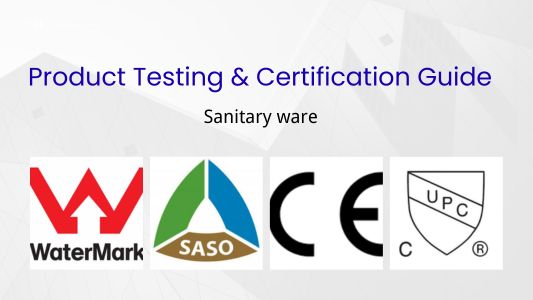
- cUPC (USA & Canada) – Required for plumbing products (toilets, sinks, faucets and shower sets).
- CE Marking (Europe) – Mandatory for most bathroom products (indicates compliance with EU health, safety, and environmental standards) entering the EU.
- WaterMark (Australia & New Zealand) – Mandatory plumbing certification.
- PUB (Singapore) – Required for water efficiency compliance, Mandatory Water Efficiency Labelling Scheme (MWELS) requires the products like toilets, taps, mixers etc are tested and labeled before sale.
- SABER (Saudi Arabia) – Required for import compliance.
- ESMA/ECAS (now MoIAT, UAE) – required to meet safety and quality standards before they can be legally imported, distributed, or sold.
- NOM (Mexico) – Required for legal sale.
- INMETRO (Brazil) – Mandatory certification for sanitary ware products.
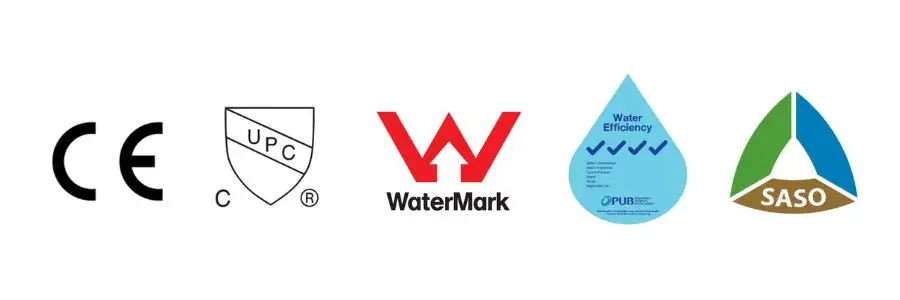
Without these certifications, products may be rejected at customs or cannot be legally sold.
Additional Certifications (Performance & Project Requirements)
In addition to mandatory certifications, some certifications are not required for market entry but are important for product performance, sustainability, safety, and project specifications.
These certifications can improve product competitiveness and are often required in commercial projects or by large distributor and retailers.
- WaterSense (USA) – Demonstrates water efficiency and is often required for government or large-scale projects
- WELS (Australia) – Provides water efficiency ratings and influences purchasing decisions
- ADA Compliance (USA) – Required for accessibility in commercial and public buildings
- WRAS (UK) – Demonstrates compliance with water safety regulations for products in contact with potable water. Especially in commercial and project-based applications. It helps ensure that materials do not contaminate water and meet hygiene standards.
While these certifications are not always mandatory for import, they can significantly impact product acceptance, especially in projects, tenders, and high-end markets.
Sanitary Ware Certification Overview by Market
The table below summarizes the key certifications, including which are mandatory for market entry and which enhance product competitiveness.
| Certification | Region | Type | Required for Market Entry | Purpose |
|---|---|---|---|---|
| cUPC / UPC | USA & Canada | Mandatory | Yes | Ensures plumbing safety and compliance with local codes |
| CE Marking | Europe | Mandatory | Yes | Confirms compliance with EU safety, health, and environmental standards |
| WaterMark | Australia & New Zealand | Mandatory | Yes | Required approval for plumbing products |
| SABER / SASO | Saudi Aabia | Mandatory | Yes | Ensures products meet import and regulatory requirements |
| NOM | Mexico | Mandatory | Yes | Required certification for legal sale and compliance |
| PUB | Singapore | Mandatory | Yes | Ensures water efficiency and regulatory compliance |
| ESMA/ECAS (now MoIAT) | UAE | Mandatory | Yes | Required products meet safety and quality standards for UAE market |
| WaterSense | USA | Additional | No | Demonstrates water efficiency, often required for projects and government programs |
| WELS | Australia | Additional | No | Provides water efficiency ratings influencing purchasing decisions |
| ADA Compliance | USA | Additional | No | Required for accessibility in commercial and public projects |
| WRAS | UK | Additional | No | Ensures water safety and suitability for potable water systems |
Before exporting, always confirm the required certifications for your target market and verify them with your supplier.
How to Verify Supplier Certifications?
Certification fraud does exist. Verifying certificates before placing an order is essential to avoid compliance risks and costly mistakes.
Red Flags to Watch For
Be cautious if you notice:
- No certificate number or unclear identification
- Missing expiration dates
- Poor quality logos or formatting errors
- Supplier unwilling to provide verification details
- Test results that exactly match minimum standards
How to Verification Certifications
Use these techniques to verify methods:
- Direct Verification: Contact the certification body using the certificate number.
- Online Database Checks: Check online directories from certification bodiesdatabases.
- UPC/cUPC: IAPMO online directory.
- WaterSense: EPA partner database.
- Third-Party Verification: Use inspection or compliance agencies if needed.
- Test Report Analysis: Request full reports, not just certificates.
Documentation You Should Request
Always ask for these documents:
- Original certification documents.
- Full test reports.
- Product scope (which models are covered).
- Certification validity or renewal documentation.
Practical Tip
Always verify certifications before placing an order, especially when working with a new supplier.
Verifying certifications is only one part of the purchase process.
Choosing a reliable supplier is also very important, as certification alone does not guarantee consistent product quality or smooth cooperation.
👉 You may also find this guide helpful: How to Find a Reliable Sanitary Ware Supplier in China.
What Testing Is Required for Sanitary Ware Products?
Different sanitary ware products require different types of testing, depending on their function and usage. Understanding these tests helps you evaluate product quality and avoid issues after installation.
Below are the key testing areas for the two main product categories.
Toilets and Bidets
Toilets undergo the most comprehensive testing, as they involve both structural strength and functional performance.
Performance Testing
- Flush performance: Testing full and partial flush effectiveness
- Waste removal: Verifies clearing power using standardized test media
- Trap function: Ensuring proper siphoning function and seal restoration
- Bowl cleaning: Evaluating bowl-cleaning effectiveness
- Water consumption: Measure water usage per flush
Structural Testing
- Load test: Typically 400-500 lbs to ensure strength and safety
- Impact Resistance: Testing durability of the bowl and tank
- Thermal Shock Resistance: Evaluates resistance to temperature changes
Material Testing
- Water Absorption: Indicates ceramic density and durability
- Chemical Resistance: Testing against common cleaning chemicals products
- Surface Finish: Evaluating glaze quality and defects
Specific Tests by Market
- MaP Testing (North America): Maximum performance testing using realistic waste simulation
- Noise Level Testing (Europe/Asia): Measuring flush sound levels
Bathroom Sinks
Bathroom sink testing focuses more on usability, installation stability, and surface durability.
Performance Testing
- Drainage capacity: Measures how quickly water drains
- Overflow function: Ensures overflow system works properly
- Water retention: Checking proper basin design and usability.
Structural Testing
- Load Capacity: Static weight testing (particularly for wall-hung models)
- Mount Strength: Tests fixing points and installation stability
- Impact Resistance: Drop tests for durability
Material Testing
- Water absorption: Measuring porosity of the ceramic
- Stain resistance: Testing against common bathroom substances
- Surface hardness: Evaluating scratch resistance
Key Sanitary Ware Tests Overviews
| Test | What It Verifies |
| Flush performance | Whether the toilet clears waste effectively |
| Water consumption | Compliance with water efficiency standards |
| Load test | Structural strength and safety |
| Water absorption | Durability and resistance to staining |
| Surface inspection | Visible defects and glaze consistency |
| Drainage test | Sink usability and water flow efficiency |
Commonly Overlooked Tests (But Critical in Real Orders)
Many quality issues do not come from basic testing, but from details that are often overlooked during production and inspection. These issues usually appear only after shipment or installation.
Packaging Durability Test
Sometimes, products can pass all factory tests but still have arrive damaged.
- Check carton strength and internal protection
- Pay special attention to edges and fragile areas
- Confirm packaging method for container or pallet shipment
👉 Weak packaging is one of the most common causes of damage during shipping
Surface Inspection Under Proper Lighting
Small defects are often missed under poor lighting conditions.
- Inspect products under standardized or strong lighting
- Look for pinholes, uneven glaze, or color differences
👉 Surface defects are a major source of customer complaints
Assembly & Installation Check
Some issues only appear during installation.
- Verify fitting accuracy and alignment
- Check mounting stability (especially for wall-hung products)
👉 Poor installation compatibility can lead to project delays or returns
Final Random Inspection Before Shipment
Even if factory inspections are done, issues can still occur.
- Conduct random checks on finished goods
- Focus on key functions and visible quality
👉 Helps catch last-minute defects before shipment
All these checks are often overlooked, but they can make a significant difference in reducing complaints and returns.
How to Plan Your Testing Strategy
After understanding what tests are required, the next step is knowing when and how to apply them in real orders.
A clear testing plan helps reduce risks without unnecessary cost.
When to Test
A simple and effective approach includes:
- Pre-production – confirm samples meet requirements before mass production
- Pre-shipment – verify finished products match approved samples
👉 These two checkpoints cover most quality risks for importers.
How to Plan Testing
Instead of testing everything, focus on key risks:
- Prioritize critical functions (flush, drainage)
- Check structural safety (load, mounting)
- Confirm surface quality and consistency
- Dimensions for rough-in
- Overall product Dimensions
👉 The goal is not more testing, but smarter testing.
How to Reduce Risk
- Do not rely only on supplier claims or certificates
- Always compare samples with production goods
- Conduct random inspections before shipment
- Verify test reports and key specifications
👉 A simple but consistent process can prevent most common issues.
FAQ:
Q1: Do I need certification before placing an order?
Ideally, yes. You should confirm certification requirements before placing an order, especially for your target market.
If certification is required but not prepared in advance, it can lead to delays, additional costs, or even shipment rejection.
Q 2: How often do certifications need to be renewed?
Most sanitary ware certifications require renewal every 1-5 years, with annual testing being most common. Many certification programs also require periodic factory audits (typically annual) to ensure ongoing compliance.
Q 3: Who is responsible for certification costs – importer or manufacturer?
Responsibility varies based on your supplier relationship and negotiating leverage. Established manufacturers often have existing certifications for standard products and include these costs in pricing. For customized products, certification costs are typically negotiable, with larger orders giving importers more leverage. Always clarify certification responsibility in writing before placing orders, as assumptions can lead to costly surprises later.
Q 4: What happens if products fail inspection at customs?
Customs rejection due to certification issues can be devastating. Products may be held, returned, or even destroyed. Remediation options include: providing missing documentation (if it’s just a paperwork issue), obtaining emergency testing for minor compliance issues, rerouting to markets with less stringent requirements, or returning products to the manufacturer. Prevention through pre-shipment verification is far less costly than remediation after customs problems.
Q 5: How do changes to products affect existing certifications?
Even minor product modifications can invalidate certifications. Generally, cosmetic changes (like color) have minimal impact, while any changes affecting performance, dimensions, materials, or structural elements require recertification. Always notify certification bodies of any product changes, as unauthorized modifications can result in certification revocation.
Q 6: What is the difference between certification and testing?
Certification is official approval that a product meets specific standards required for a market.
Testing is the process used to verify product performance, safety, and quality—both for certification and for internal quality control.
In simple terms, certification allows you to sell the product, while testing ensures the product performs as expected.
Q 7: Do I need to test every order?
Not necessarily.
However, you should at least conduct basic verification for each order, especially when working with new suppliers or new product models.
For repeat orders with stable suppliers, random inspections or periodic testing is usually sufficient to maintain quality consistency.
Conclusion
Quality control in sanitary ware is not just about meeting technical standards—it directly impacts product performance, compliance, and customer satisfaction, it can open access to regulated markets and projects.
For importers, Understand certification requirements early, integrate testing into your process, and clearly define responsibilities with your suppliers, all these can significantly reduce risks and avoid costly mistakes.
If you are new to certification, start with your core products and main markets, then expand as your business grows. Working with experienced partners can make the process much smoother.
Have questions about certification for a specific product or market? Drop a comment below or contact me directly for personalized guidance based on your importing needs.