China is one of the largest tile producers and exporters in the world. According to published figures, it produced around 52% of the world’s ceramic tiles in 2020. Because of its multiple designs, durability, and economical price, Chinese tiles have increased their popularity among international importers over the years. In this post, we will discuss everything you need to know when purchasing China ceramic or porcelain tiles.
From understanding the difference between ceramic and porcelain, to navigating China’s major production regions, evaluating suppliers, and managing logistics — this guide covers the full sourcing journey. If you’re interested, please keep reading.
Are ceramic tiles made in China good?
The short answer is yes — but only if you know what you’re looking for.
I’ve been working in the ceramic tile industry for years, both as a supplier and as someone who sources products directly from Chinese factories. And the truth is, China produces everything from world-class, export-grade porcelain to low-grade products that will give any importer a headache. Both exist, and both get exported.
So when buyers tell me they’ve had a bad experience with Chinese tiles, I always ask the same question: where exactly did you source them, and how did you choose that supplier?
In most cases, the problem wasn’t China — it was the sourcing decision.

Here’s why opinions on Chinese tile quality vary so much:
- Different quality standards across markets
The perception of quality can vary significantly from one region to another due to different quality standards and expectations. What may be considered high-quality in one market might not meet the standards in another. China manufactures tiles across every quality tier — premium, mid-range, and budget. If you don’t clearly define your quality requirements upfront, you’ll get whatever the factory thinks fits your budget.
Also, some salespeople in China may have a misunderstanding: they assume that buyers from developing countries only care about low prices. As a result, in order to close the deal, if you push for very low pricing, they may supply products with compromised quality.
- Variety of tile manufacturers
China has numerous tile manufacturers, ranging from large listed companies with international certifications to small workshops with minimal quality control. The factory you choose matters enormously. A tile from a top Foshan manufacturer and a tile from a small Shandong workshop may look similar in a photo but perform very differently on site.
- Supplier selection
Many buyers who’ve had bad experiences with Chinese tiles were simply working with the wrong supplier — one who prioritized price over consistency. Reputable suppliers maintain quality standards because their business depends on repeat orders from international buyers. The importers who get burned are usually the ones who chose a supplier based on the lowest quote alone.
The bottom line: Chinese ceramic tiles can be excellent. But quality is not automatic — it’s the result of knowing which region to source from, which factory tier suits your needs, and how to verify the quality before it ships.
That’s exactly what this guide is here to help you with.
Ceramic vs. Porcelain: essential differences importers must understand
Although, we generally refer to all tiles—including porcelain and ceramic tiles—as ceramic tiles, which is a broad phrase. But in a narrow sense, ceramic and porcelain tiles differ in materials, manufacturing techniques, and performance characteristics.
So, for most importers, the common questions face is understanding the distinction between ceramic and porcelain tiles. This is important for selecting the right product for your market needs. Below are some comparision for you to understand easier.
Material composition and manufacturing
| Characteristic | Ceramic Tiles | Porcelain Tiles |
| Raw Materials | Clay, quartz, feldspar | Refined clay, kaolin, quartz, feldspar, silica |
| Firing Temperature | 900°C-1,100°C | 1,250°C-1,450°C |
| Water Absorption | wide ranges: 0.5%-20% | Less than 0.5% |
| Density | Lower | Higher |
| Production | ProcessSingle-fired or double-fired | Usually single-fired |
Performance characteristics comparison
| Performance Factor | Ceramic Tiles | Porcelain Tiles |
| Durability | Good | Excellent |
| Moisture Resistance | Moderate | High |
| Frost Resistance | Limited | Excellent |
| Stain Resistance | Good | Excellent |
| Application Range | Indoor, low-traffic | Indoor/outdoor, all traffic levels |
| Price Range | More affordable | Higher price range |

Generally speaking, based on the basic characteristics of ceramic and porcelain tiles, we recommend porcelain for:
- All floor applications, especially high-traffic areas,
- Outdoor installations,
- Moisture-prone areas like showers and pool surrounds,
- Commercial spaces where durability is paramount, such as airport, hospital, hotel lobby etc.

While Ceramic tiles are ideal for:
- Residential wall applications,
- Light-traffic residential floors,
- Budget-conscious projects,
- Applications where frequent design changes are anticipated.
Understanding these nuances helps you position the right products for specific project requirements.
If you want a deeper understanding on how to choose the right ceramic or porcelain tile for your projects or markets, read our post Ceramic vs Porcelain Tile: B2B Buying Guide and Types of Porcelain Tiles: Essential Knowledge for Importers.
Next, we will talk about the main types of tiles in China.
What types of ceramic and porcelain tiles does China produce?
China’s tile industry covers every market segment — from basic commodity products to high-end designer collections. This section we will explore main tile types you’ll encounter when sourcing in China.

Polished porcelain tiles:
Polished tile are fired and then mechanically polished to achieve a high-gloss, mirror-like surface. They’re highly durable, resistant to scratches, and easy to clean, and visually make spaces look more spacious and brighter. It’s widely used in dry indoor floors and high-end residential or commercial halls. However, they can be slippery on wet floors, like bathrooms and kitchens.

Glazed rustic tiles :
Also called matte tiles or vintage tiles, these are designed to replicate natural materials — wood, stone, cement, slate — with remarkable realism thanks to advances in digital printing.
They come in both ceramic and porcelain bodies, and the style range has expanded significantly in recent years toward modern and neutral. With their remarkably realistic texture and finishes, it becoming increasingly popular.

Porcelain marble tiles
Not to be confused with natural marble — these are porcelain tiles engineered to mimic the look of marble, complete with realistic veining and surface texture. Since its variety of patterns & designs, the luxurious looks of marble without the high cost, low water absorption, and easy maintenance, it has been one of the fastest-growing tile types in the premium residential segment globally.

Want to know the comparision between natural marble and the porcelain marble tile?
👉 Read our detailed guide before you make decision: The Battle of Tiles: Porcelain vs Marble.
Full body porcelain tiles:
Full-body tiles, also known as homogeneous tiles, are made of the same color and material composition throughout their entire surface and body. As a result, they are extremely durable and resistant to wear and tear. Making them a practical choice for commercial floors, shopping malls, airports, car parks, hospitals, and outdoor areas.
For more information, see our full guide on Homogeneous Tiles: A Versatile Solution for Your Flooring Needs

Ceramic wall tiles
In general, ceramic wall tiles are lighter and thinner than floor tiles.
Their higher water absorption rate actually works in their favor here, which means the tile may better stick to the glue used to connect it to the wall, greatly reduces the risk of tiles peeling over time. Available in a wide range of sizes, colors, and finishes, they remain one of the most accessible and price-competitive tile types for residential projects.

Decorative and Encaustic tiles
Drawing from global design traditions — Moroccan, Mediterranean, geometric, encaustic — Decorative tiles are used as feature walls, backsplashes, and accent areas rather than full-floor installations. They’re not a volume product, but they add significant design value to a collection and are particularly popular with buyers targeting the premium residential or hospitality market.

Each types of tile has its own advantages and is best suited for specific applications. It’s always important to choose the right type of tile based on the requirements of your commercial projects.
What surface finishes, tile size and thickness options in China
Finishes, size and thickness are some of the factors you need to pay attention. Understand these options and know which one actually work for your market. Here’s a breakdown of what’s available and how to think about each.
Surface finishes
The finish you specify affects not just aesthetics, but performance, safety, and maintenance — and different markets have different preferences.
Polished finishes achieve a high-gloss, mirror-like surface. Ideal for luxury residential and upscale commercial spaces. Avoid specifying these for bathrooms, kitchens, or any wet area without checking the slip resistance rating first.
Matte finishes provide a natural, non-reflective appearance that hides stain and footprints more effectively than polished surfaces. The most versatile finish for everyday residential and commercial use. If your market or project trends toward contemporary or minimalist design, this is a safe option.
Textured/Anti-slip finishes Designed for wet areas and outdoor applications. Modern versions provide solid grip without the rough, hard-to-clean surfaces of older generations. It’s essential for bathrooms, patios, pool surrounds, and exterior walkways.
Lappato (semi-polished) finishes strike a balance between polished and matte, with a subtle sheen that provides visual sophistication while being more forgiving than fully polished surfaces in terms of maintenance and slip resistance. It’s a good option if your project want a premium look but are concerned about slip resistance.
Structured surfaces include three-dimensional textures that mimic natural materials with remarkable realism—wood grain, split stone, brushed concrete, and other tactile effects that add depth and character to installations. These add design value and work particularly well for feature walls and accent applications.
For a detailed breakdown of each finish type — including slip resistance ratings, suitable applications and market — see our full guide to porcelain tile types.

Size and format options: from traditional to large format and beyond
In China, as the evolution of manufacturing capabilities has dramatically expanded size options:
Traditional formats (300×300mm, 300*600mm, 600×600mm) still wildly used for their versatility and economical installation. Competitive pricing and widely available from most factories.
Large format tiles (800×800mm, 900*900, 600×1200mm, 750*1500mm, 900×1800mm) create dramatic, nearly seamless installations with minimal grout lines. These have gained tremendous popularity for their ability to make spaces feel larger and more continuous. Pricing has come down significantly as more factories have invested in large-format equipment. If you’re not already carrying these, and your market can accept big size, it’s worth adding them.
If you want to go a step further, porcelain slabs take the large-format concept to its logical extreme — but they come with a different set of considerations.
Porcelain slabs (1200×2400mm and larger) represent the cutting edge of tile technology, providing seamless surfaces for countertops, wall cladding, and floor applications. These compete directly with natural stone slabs while offering superior technical performance. Higher price range, more complex logistics, and not every factory produces them consistently. Better to source carefully and only from established Guangdong manufacturers.
Plank formats designed specifically for wood-look tiles ( 150*600mm, 150*800mm, 150×900mm, 200*1000mm, 200×1200mm, 250*1500mm, etc.) mimic the proportions of hardwood flooring for authentic installations. If wood-look is a strong category in your market, getting the format right matters as much as the surface pattern and color
Special shapes including hexagons, penny rounds, arabesque, and other decorative formats provide distinctive design options for creating unique installations. These are not volume product but high-margin.
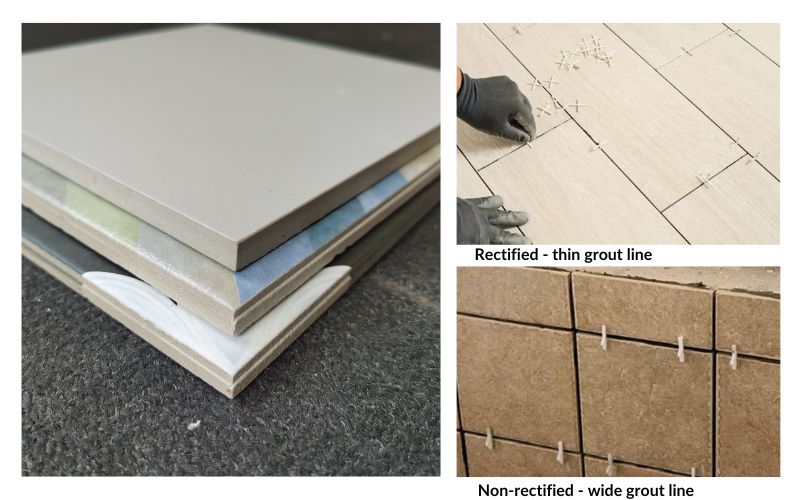
Rectified and Non-Rectified Edges, which one fit for you?
When buying tile from China, it is worth knowing that tiles come in two main edge types: rectified and non-rectified. Rectified tiles have been mechanically cut after firing for precise, straight edges, while non-rectified tiles retain their natural edges from the manufacturing process. They are more affordable and work beautifully in rustic, vintage, or earthy design styles.
Each edge type suits different design styles and installation requirements. To understand which one is the better fit for your project, check out our detailed guide on rectified vs non-rectified tiles.
Thickness options for specialized applications
Standard thicknesses (8-12mm) remain the most common for wall and floor applications. Widely available, easy to load and install. No special considerations needed.
Thin tiles (4-6mm) offer advantages for renovation projects, where minimizing floor height changes is important, and for wall applications where weight is a concern. Not all factories produce these consistently — verify quality carefully before placing a large order.
Thick porcelain pavers (20mm) designed specifically for outdoor installation have revolutionized exterior design, providing frost-resistant, non-slip surfaces for patios, walkways, and pool surrounds that can be installed over various substrates. Logistics require more attention due to weight.
In recent years, China manufacturing capabilities now account for more than 50% of worldwide ceramic tile production, this is closely related to the fact that China has many ceramic production areas. Now let’s explore China’s ceramics production areas in-depth.
The major Chinese tile manufacturing regions and their specialties.
There are several regions in China that produce ceramic and porcelain tiles. We’ll go over four major manufacturing regions and their specializations in this section. Guangdong, Fujian, Shandong, and Sichuan are the four production regions that account for over 60% of total domestic ceramic tile production in China.
Guangdong province:
In Guangdong region, which includes cities such as Foshan, Qingyuan, Zhaoqing, Dongguan, Enping, and Heyuan, is recognized for producing high-quality tiles in a broad range of types, including porcelain polished tiles, glazed tiles, marble porcelain tiles, full-body tiles, wall tiles, mosaic tiles, border tiles, and stair tiles.
The Guangdong region not only excels in producing a broad spectrum of ceramic tiles but is also renowned for its quality products that cater to the international quality standards. Many tile brand from overseas like OEM or ODM in the Guangdong tile manufacturer.
Foshan, in particular, is a standard in China’s ceramic tile industry, since it is home to the headquarters or marketing centers of the majority of leading ceramic tile enterprises, significantly influencing the trend of Chinese tiles.
In general, Guangdong continuously ranks top among all major areas in terms of production scale, manufacturing technology advancement, product development, quality control, product diversification, enterprise management, industrial support, and logistics. The region’s diverse and high-quality tile demonstrates its importance in the Chinese tile production field.
If you have read our post TOP 10 ceramic tiles manufacturer in China, you may know seven of the top 10 brands are from Guangdong, then you will know how important Guangdong Province’s position in the China ceramics industry.

Fujian province:
The main producing cities in the Fujian region are Jinjiang and Minqing. Fujian factories are frequently on a smaller scale, with flexible manufacturing processes. It is recognized for its glazed tiles and exterior tiles, but Minqing is noted for its cheap but low-quality ceramic interior wall tiles.
A Filipino customer once told me he bought a batch of tiles in Fujian. They were inexpensive but of low quality. When water was poured on the tile’s surface, it would run out from the back of the tile, it’s totally not resistant to water.
Shandong province:
The Shandong Region, with its principal production cities of Zibo and Linyi, is recognized for its specialty in producing glazed tiles, including glazed polished tiles, rustic tiles, and ceramic wall tiles. Most of these tiles are with high water absorption, not porcelain. Its primary advantage lies in its more affordable pricing and lower minimum order quantities, making it an appealing choice for many buyers.
However, the average production technological level in Shandong is slightly lower than that in Guangdong or Fujian province, resulting in products that are mainly targeted towards the middle-to-low-end market.
I recall an experience from about seven years ago when I was working for a trading company, they had a partnership with some tile factories in Shandong. What impressed me was I got a ceramic tile order for a project at the Canton Fair. After receiving the deposit, I immediately arranged for our team to prompt the factory to start production.
Originally, the contract stipulated a delivery period of 20 days. However, even after a month, production had not commenced. The final delivery period was extended to nearly 60 days.
That’s a really terrible experience.
Sichuan province:
Centered around Jiajiang, this region mainly produces ceramic wall tile. It is characterized by small-scale production and cheaper prices. Despite this, its location in the inland region of China does not provide any logistical advantage.
In addition to these four major tile manufacturing regions, some emerging tile production centers have appeared in recent years. For example, the Guangxi region, centered around Beiliu and Guigang, and the Jiangxi region, centered around Gao’an, Pingxiang, Jiujiang, and Jingdezhen, mainly produce glazed tiles. These regions are gaining more and more influence in the field of tile manufacturing.
Each region produces a variety of ceramic tiles or porcelain tiles in its unique way, with different prices and quality positioning to meet the diverse needs of consumers both domestically and internationally.
After clearing the tiles production areas in China, you may have a question:
How to choose good-quality tiles?
Undoubtedly, quality is a key consideration for all buyers, regardless of price. Even if you are sourcing budget tiles, you will expect an acceptable level of quality and consistency. Right?
From my experience sourcing and supplying tiles, these are the three factors that most directly determine whether a tile will perform well in the field:
Water absorption rate:
The water absorption rate of a ceramic tile is the single most important technical indicator. It tells you how dense the tile body is — and directly affects durability, stain resistance, and suitability for different environments. Porcelain tiles have a water absorption rate of ≤0.5%, making them suitable for floors, outdoor use, and wet areas. Ceramic wall tiles typically absorb 3% or more, which is fine for interior walls but not suitable for commercial floors or exterior applications.

Abrasion resistance:
Abrasion resistance refers to the tile’s ability to withstand abrasion and wear over time. Higher wear resistance indicates that the tile will keep its beauty and usefulness even when subjected to heavy use or harsh conditions. It is an essential metric that shows a porcelain tile’s durability. For high-traffic commercial projects, make sure the abrasion resistance which can matches the application

Flatness:
A tile’s flatness can impact both its visual appeal and the installation process. This not only improves the appearance of the finish, but also improves safety by reducing the chance of trips and falls caused by uneven surfaces. This is one of the most common complaints I hear from importers after goods arrive. If for large projects, it’s worth to find a 3rd party inspection organization to check the quality before loading. Don’t assume it — verify it with samples.

These three factors are your baseline checklist for any tile order. For a more comprehensive guide on evaluating quality, including stain resistance and size tolerance, see our full article on how to choose high quality tiles.
Quality Standards and Testing
The tile industry operates under several recognized international standards that provide a common language for specifying technical performance.
Knowing the quality standards doesn’t make you an expert — but not knowing them puts you at a disadvantage when talking to suppliers or dealing with quality disputes. Here’s what actually matters in practice.
The standard you’ll see most often:
ISO 13006/EN 14411 represents the global benchmark for ceramic tile classification. It categorizes tiles by water absorption rate, which is why it directly connects to everything we discussed in the previous section:
- Class BIa: Porcelain tiles (water absorption ≤0.5%) — floors, walls, outdoor, and wet areas.
- Class BIb: Stoneware tiles (water absorption 0.5-3%) — general floor use.
- Class BIII: Wall tiles (water absorption >10%) — interior walls only.
One important caution: reputable tile manufacturers can and do provide test certificates — but always verify that reports come from an accredited third-party laboratory, not an in-house test.
Critical technical parameters beyond water absorption
Beyond water absorption, these are the technical parameters that matter most when specifying tiles for specific applications:
Breaking strength and modulus of rupture indicate how much load a tile can take before it breaks. These become particularly important for floor applications, especially in commercial environments. The minimum requirements vary by thickness, but generally, porcelain tiles should exceed 1300N breaking strength and 35 N/mm² modulus of rupture. If a supplier can’t provide these numbers, that tells you something.
Mohs hardness (typically 4-8 for tiles) indicates scratch resistance and helps determine suitability for different environments. Higher is better for high-traffic environments.
Slip resistance is critical for floor tiles, especially in commercial or wet environments. The standard varies by market:
- In the United States, DCOF ≥0.42 (ANSI A326.3).
- Europe, R-rating R9–R13 (higher = more grip)
- Australia, P-rating P1-P5, (higher = more grip).
Asking a supplier for “slip-resistant tiles” without referencing a specific standard is a recipe for misalignment.
How can we find China tile suppliers?

The foundation of successful importing begins with selecting the right products and suppliers. Finding reliable suppliers we can be approached through multiple channels: visiting the tile production areas, attenting the trade show, or via the online platform, such as alibaba, made in china, google search engine or social media, etc.
Visiting production areas and attending the trade shows
First, visit the tile manufacturing regions or attend the ceramic industry exhibitions, which are the most reliable ways to find ceramic tile suppliers in China. If your budget and time are available, a firsthand examination of China is very efficient and necessary. You can see the quality of the products, the production management, and the most important thing is that you can communicate with a person face to face, rather than the usual computer.
Below are some of the key exhibitions in the tile industry:
Canton Fair (Guangzhou, China), China International Ceramic & Bathroom Fair (Foshan, China), Cersaie Exhibition (Italy), Cevisama Expo ( Spain), Big 5 Global (Dubai), Covering Show (USA) and Feicon Batimat (Brazil).
If you’re looking for porcelain tile suppliers online, there are many platforms and strategies you can use. Here are a few popular options:
Google search
The world’s largest search engine can be a great starting point. You can use specific keywords related to your product and add terms like “supplier,” “manufacturer,” or “wholesaler” to find potential leads.
B2B platform: Alibaba, Made in China, Global Sources
All these 3 are the largest and most popular B2B e-commerce marketplaces based in China. You can connect businesses with different kinds of product suppliers on the platform.
For deeper information about the menthods to find and evaluate suppliers, please read our previous post how to find reliable tile suppliers in china for additional resources and expert advice.
Tile manufacturer or trading company?
Once you’ve identified potential suppliers, you’ll quickly realize that not everyone presenting themselves as a “manufacturer” actually is one. Understanding who you’re dealing with — and choosing the right type of supplier for your situation — can save you a lot of trouble.
Tile manufacturers are the actual producers of the goods. Working directly with manufacturers typically means lower prices. more control over product quality, production schedule, and customization options. However, they may require a larger minimum order quantity (MOQ) and a narrower product range — most factories specialize in specific tile types rather than offering everything.
Trading companies source from multiple manufacturers, which gives them broader product variety and more flexibility on MOQ. They can also handle logistics, customs clearance, and consolidation across factories — which can be more convenient if you’re sourcing a mixed container or new to importing from China. You’ll pay a margin for these services, but for the right buyer, that margin is worth it.
My honest take: if you have the large volume, rich experience, a clear product focus and want strong quality control, go direct with a manufacturer. If you’re still building your supplier network, exploring different tile options for projects, dealing with mixed orders, or want someone to manage the complexity on your behalf, a reliable trading company is a perfectly legitimate choice. The goal is finding a supplier who suits your specific situation — not chasing the lowest price at any cost.
How to distinguish who you’re actually dealing with?
Most suppliers will claim to be manufacturers. Here’s how to verify:

1. Product Range:
Manufacturers usually specialize in specific products. If a supplier confidently offers polished and glazed porcelain tile, ceramic wall tile, outdoor paver all at once, that’s a trading company. Factories have specific production lines and don’t jump across tile categories easily. The broader and more varied the catalogue, the more likely you’re talking to an intermediary.
2. Company and warehouse location:
The location of a company can often provide clues about its nature. Companies located in industrial or manufacturing regions are more likely to be manufacturers, while those in other production cities are often trading companies.
In addition, the warehouse location for loading tiles can also serve as an indicator. If you’re sourcing several tile models and they’re coming from different warehouses, these products are likely coming from different factories — someone is consolidating them for you, and that someone is a trading company.
3. Speak with Factory Workers:
If you can visit the factory, you can try speaking with the factory workers to get more direct information. Management might say they are manufacturers when they might be a trading company. At the same time, observe the communication between the salesperson and the workers, the familiarity with the factory production, the machinery and the products displayed in the showroom, will tells you more than anything they say.
Whichever type of supplier you work with, reliability matters more than the label. A well-run trading company will consistently outperform a disorganized manufacturer. Focus reliability, responsiveness, and quality consistency — not just on whether they have a production line.
Pricing Factors in the Chinese Tile Market
Pricing is naturally a key consideration when importing tiles. Pricing structure in the Chinese tile industry incorporates multiple factors that influence the final cost. Understanding these elements helps you negotiate effectively and develop realistic budgets.
Raw Materials and Production Technology
The quality of raw materials significantly impacts tile pricing. Premium grade clays, feldspars, and high-quality pigments increase manufacturing costs but result in superior products.
Production complexity also affects pricing. Rectified tiles (precision-cut after firing for exact dimensions) command higher prices due to the additional processing steps involved.
Energy represents a major cost component in ceramic manufacturing, as kilns operate at extremely high temperatures. Fluctuations in energy prices directly impact production costs and, consequently, tile pricing.
Size, Thickness, and Surface Treatments
Large-format tiles require specialized equipment and more precise manufacturing controls, resulting in higher costs per square meter. Additionally, larger tiles typically have higher rejection rates during production, further increasing per-unit costs.
Thickness directly correlates with material usage—a 20mm outdoor paver contains twice the raw material of a 10mm tile of the same design. Similarly, surface treatments add cost:
- Polishing requires additional machinery and processing time,
- Anti-slip treatments add manufacturing steps,
- Special effects like metallic finishes involve more expensive materials,
- Full-body coloration uses more pigments throughout the tile body.
Quality Grades and Sorting
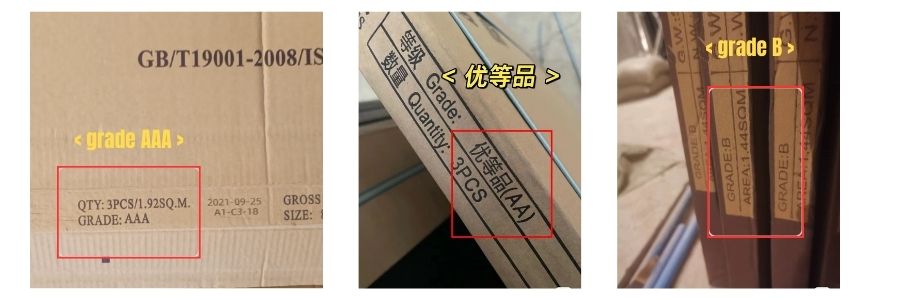
Most factories produce several grades of the same design. Understanding these distinctions helps importers source appropriately for their market segment:
First choice/Grade A tiles meet all specifications for dimensions, flatness, and visual appearance. They represent the highest quality and command premium prices.
Commercial grade/Grade B tiles may have minor variations in tone, texture, or dimension that don’t affect functionality but might not meet the strictest aesthetic standards. These typically sell at a 15-30% discount from first choice.
Second choice/Grade C tiles have noticeable imperfections but remain usable. These are often sold at 40-60% below first choice prices and may be suitable for budget projects or areas where appearance is less critical.
The price difference between grades becomes particularly significant when dealing with high-end products, where first-choice goods may command substantial premiums.
Other Factors
- Order volume dramatically impacts pricing, with significant discounts typically available for larger quantities. The optimal volume for pricing efficiency often starts around 1,000-2,500 square meters per design, with further discounts at higher volumes.
- Long-term relationships also influence pricing. Consistent buyers typically receive preferential rates compared to one-time purchasers, as factories value stable business relationships that allow for more efficient production planning.
- Seasonal factors affect pricing as well. Energy costs typically rise during winter months, and production often slows around Chinese holidays, particularly Chinese New Year (January/February). Planning orders to avoid these peak periods can result in more favorable pricing.
Current Market Price Ranges (2025 Update)
Note: These are approximate FOB China ranges and vary based on specifications, quantity, and market conditions. Strictly speaking, there is no clear dividing line between Economic Grade, MDI-range and Premium. All the above data just only be used as a reference.
| Type | Economic Grade (USD/m²) | Mid-Range (USD/m²) | Premium (USD/m²) |
| Ceramic Wall Tiles | $2.00-$4.50 | $4.50-$7.50 | $7.50-$15.00 |
| Ceramic Floor Tiles | $3.50-$5.50 | $5.50-$8.50 | $8.50-$16.00 |
| Standard Porcelain | $4.50-$6.50 | $6.50-$11.50 | $11.50-$20.00 |
| Polished Porcelain | $4.50-$6.50 | $6.50-$10.00 | $10.00-$26.00 |
| Large Format Porcelain | $7.50-$13.00 | $13.00-$21.00 | $21.00-$38.00 |
| Special Design Series | $6.50-$11.00 | $11.00-$19.00 | $19.00-$45.00+ |
| 20mm Outdoor Pavers | $10.00-$15.00 | $15.00-$25.00 | $25.00-$40.00 |
Calculating Total Landed Cost
FOB (Free On Board) pricing represents only part of your total cost. For accurate budgeting, consider these additional expenses:
Shipping costs: Except the Asian country, currently averaging $1,000-$3,500 per 20-foot container, depending on destination port (containing approximately 900-1300m² of tiles, depending on type and size).
Import duties, Customs clearance and port fees: Vary significantly by country.
Inland transportation: From port to warehouse (varies by distance).
When negotiating with suppliers, focus on the total landed cost rather than just the FOB price. Sometimes a slightly higher FOB price from a supplier with better packaging and more consistent quality results in a lower overall cost when all factors are considered.
Order contract essentials and logistics management
Once you’ve confirm suppliers, the negotiation process begins. Beyond price, the contract and logistics details are where things can quietly go wrong if you’re not specific enough.
Contract essentials
- Product specifications: Don’t just writing a product model. Attach specify acceptable tolerances for dimensions, shade variation, and what surface finish in writing. Vague specs are the most common source of disputes.
- Packaging requirements: Specify packaging materials, carton layers, pallet and labeling requirements. Proper packaging prevents damage during transit and simplifies warehouse handling. This is often overlooked until tiles arrive damaged.
- Payment terms: Standard terms in the Chinese tile industry typically involve a 30% deposit when placing the order and 70% payment before loading. For established relationships, more favorable terms may be negotiable, such as a lower deposit percentage or payment by L/C.
- Lead times and penalties: Clearly define production scheduling, expected completion dates, and any late delivery penalties. Without it, your order will move to the back of the queue whenever the factory gets busy.
Logistics
After your orders are finished, the next step is loading and shipping. Then efficient logistics management ensures your tiles arrive safely and cost-effectively.
Sea freight is standard for ceramic and porcelain tiles. For most destinations, full container loads (FCL) offer better protection and more predictable pricing than shared containers (LCL). Typical transit times range from 15 to 45 days depending on your destination port.
Rail transport is less popular than sea and air transport, but in some landlocked nations, such as Central Asia, it is the main method of goods transit.
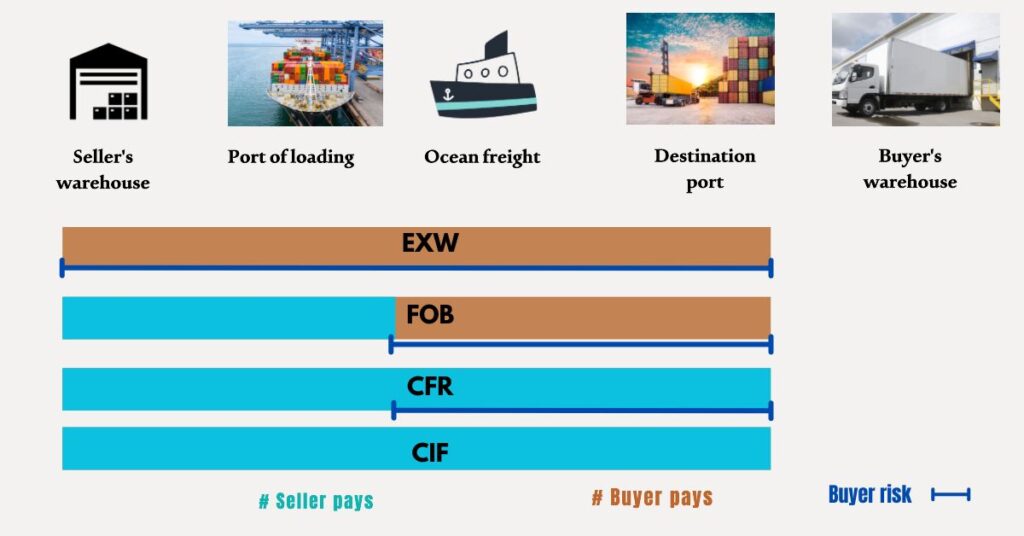
Incoterms clarification: Most Chinese suppliers quote prices on FOB (Free On Board) terms, meaning they handle export clearance and delivery to the port, you take responsibility from there. Make sure you and your supplier are aligned on exactly which terms apply before signing anything.
Other common terms include:
- EXW (Ex Works): You arrange collection from the factory,
- CIF (Cost, Insurance, Freight): Supplier arranges shipping to your destination port,
- DAP (Delivered at Place): Supplier handles delivery to your specified location.
Marine insurance: Marine cargo insurance typically costs 0.3-0.5% of shipment value but provides essential protection. Especially in some maritime incidents, if you do not get insurance, you may have to pay a high cost for it. Don’t skip it.
Documentation checklist: Confirm you have all required documents before the vessel departs:
- Packing List,
- Commercial Invoice,
- Bill of Lading
- Certificate of Origin
- Any market-specific compliance documentation.
Missing documents cause customs delays that are entirely avoidable.
In a word, shipping tiles is more complex than most importers expect.
👉 Learn the shipping cost breakdown and Preventing tile damage during shipping: optimizing logistics for ceramic and porcelain tile imports from China.
Barriers you might encounter when importing tiles from China
No import process is without risk. The most common challenges importers face when sourcing tiles from China include:
Tariffs and anti-dumping duties
Several countries have imposed anti-dumping measures on Chinese tiles, including the US, EU, Mexico, Argentina, Brazil, India, and GCC countries. These can significantly increase your landed cost. Research your country’s current duty structure before committing to an order.
For a more detailed about the anti-dumping of importing tile from China, see our guide: 6 expert tips to help you import tiles from China.

Quality inconsistencies:
Quality control is another significant concern when importing Chinese tiles. What you approved in the sample may not perfectly match what arrives in the container. Third-party pre-shipment inspection through agencies like SGS or Intertek is the most reliable way to catch problems before goods leave China.
Supplier misalignment:
There are many Chinese tile suppliers, not all of them may meet your specific needs regarding quality, price, and reliability.
In China, because of the hyper-competition, many suppliers will tend to recommend products based on your budget, so if you don’t specify quality standards, they will default to choose the cheapest price product what will fits your price point.
Conclusion
After reading this thorough guide, you should have a full idea of the factors to consider, potential problems to avoid, and solutions you can try when importing tiles from China.
Before you start importing, you should examine your country’s trade regulations, tariffs, and anti-dumping measures extensively. When selecting a supplier, whether a manufacturer or a trade organization, be sure they are dependable. If feasible, visiting them will offer you with further information.
Before making an order, check samples or trial orders to ensure they satisfy your quality requirements. Avoid focusing primarily on low-cost items.
Finally, make an effort to comprehend the cultural distinctions between the Eastern and Western worlds. You’ll easily manage the process of finding the proper tile suppliers if you have the right knowledge and approach.
Here’s to a prosperous journey importing Chinese tiles! Please contact us if you have any questions!
FAQ – about importing China ceramic tiles
1. Is porcelain tile the same as ceramic?
Porcelain and ceramic tiles are not the same, although they both belong to the category of ceramic tiles. The main difference lies in the composition and manufacturing process: porcelain tiles are denser and more durable than traditional ceramic tiles, making them ideal for high-traffic areas and outdoor use. Read our post Porcelain vs ceramic Tile for more information.
2. Which ceramic tiles are better, Indian or Chinese?
The choice between Indian and Chinese ceramic tiles ultimately depends on individual preferences and specific project requirements. There is no general answer that Chinese ceramic tiles are better or Indian ceramic tiles are better.
China makes more than half of the world’s ceramic tiles, which just goes to show they’ve got a really strong production and supply setup, not to mention stable output. When it comes to quality and price, it’s up to each buyer to figure out what works best for you based on your own requirements.
3. Why are Chinese tiles so cheap compare to other countries?
I think the main reason can be in these three reasons:
1. labor costs in China are typically lower compared to other developed country regions, contributing to overall cost savings.
2. China’s efficient supply chain and infrastructure also play a role in reducing expenses associated with transportation and logistics.
3. Because of the scale of the Chinese market, a vast number of tile manufacturers driving competition and lowering production costs.
However, price varies significantly by region, factory tier, and product grade — cheap does not always mean poor quality, but it does require careful supplier selection.
4. Which region in China produces the best tiles?
Guangdong — particularly Foshan — is widely regarded as China’s premium tile production hub, known for the widest product range, highest manufacturing standards, and strongest export track record. For buyers prioritizing quality and variety, Guangdong is the natural starting point.
5. Should I work with a tile manufacturer or a trading company?
Both have legitimate advantages. Generally, manufacturers offer lower prices and more control over production, but usually require higher MOQs and a narrower product range. Trading companies offer more flexibility and can handle logistics, but at a slightly higher cost. But you have to know, manufacturers are not always equal to the low price. The right choice depends on your order volume, product variety needs, and experience level with China sourcing.
6. How long does it take to receive tiles from China?
Production typically takes 15–30 days after deposit payment, depending on order size and factory schedule. Sea freight and customs clearing adds another 15–50 days depending on your destination port. Plan for 6–12 weeks total from order confirmation to arrival at your warehouse.
7. How do I protect myself from quality issues before a shipment leaves China?
Request pre-shipment inspection through a third-party agency such as SGS or Intertek. Before production, get a physical sample approved as the reference standard.