Porcelain tiles have become increasingly popular in global markets due to their incredible versatility and durability. If you’re sourcing porcelain tiles from China, the sheer number of options can be overwhelming. Polished or matte? Full-body or standard? Without a clear framework, it’s easy to order the wrong product for your market.
This guide cuts through the noise. In this comprehensive guide, we will explore the major tile types of porcelain tile by four dimensions the matter most to importers, application, finishes, visual style, and tile body constructruction, providing you with the essential knowledge needed to select the best options for your projects. By the end, you’ll know exactly what to ask for — and what to watch out for — when placing orders with Chinese manufacturers.
Now let’s start!
Overview: What Are the Main Types of Porcelain Tiles?
There’s no single “correct” way to classify porcelain tiles — and that’s actually part of what makes sourcing confusing. Suppliers organize their catalogs by finish. Designers specify by look. Project managers think by application.
As an importer, you need to understand all four dimensions:
- By surface treatment — This determines the tile’s appearance, slip resistance, and maintenance requirements.
- By what it looks like — Wood-look, marble-look, stone-look, concrete-look, solid color. This is what your buyers actually ask for. Knowing which looks are trending in your target market is a real commercial advantage.
- By the tile body structures— Full-body porcelain, polished tile, glazed porcelain tile. This affects durability, designs, and price point — three things that matter a lot when you’re buying at scale.
- By where it gets installed — Floor, wall, or outdoor. Application drives almost every other decision: slip rating, thickness, absorption rate, and load-bearing capacity all depend on where the tile ends up.
The sections below walk through each of these four dimensions in detail. If you’re sourcing for a specific project, start with application or finish — it’s the fastest way to narrow your options.
Let’s discuss one by one.
Porcelain Tile Types by Application
Application is the most practical starting point for any sourcing decision. Depending on where they’re going . Where a tile gets installed determines its required slip rating, thickness, water absorption tolerance, and load capacity. Each application comes with its own demands, and understanding that distinction is the first step to making a decision you won’t regret.
Floor Tiles
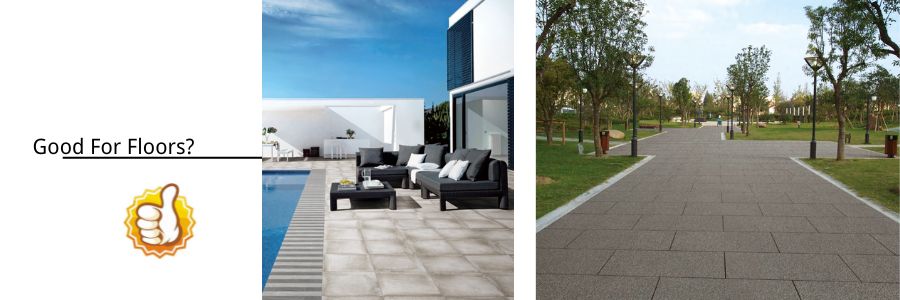
Floor porcelain tiles are engineered to withstand regular foot traffic while maintaining their appearance. These tiles typically feature:
- Higher PEI ratings (Class 3-5) to resist abrasion and wear. High-traffic commercial spaces ( such as shopping malls, airports, hotels) typically require PEI 4 or 5.
- Enhanced slip resistance, R9–R10 suits most residential and light. commercial floors. R11 and above is required for commercial floors, and outdoor areas in many markets.
- Greater thickness (usually 8-12mm) to withstand impact and pressure. For outdoor and heavy commercial use, 20mm pavers are increasingly standard in European, North America and Middle Eastern markets.
- Denser body composition for durability.
Popular formats for import: 600×600mm, 800×800mm, 600×1200mm, and 750×1500mm remain the most commercially viable sizes globally. Large-format 1200×2400mm and 1200×2700mm are growing fast in the premium segment.
For the commercial and high-traffic floors
Hotels, retail, airports, hospitals – it demand tiles that can handle years of intensive use without showing wear. The specification bar is higher across every category:
PEI 5 rating for any surface exposed to heavy traffic, trolleys, or cleaning machines. PEI 4 is acceptable for moderate commercial use such as office lobbies and restaurants.
Anti-bacterial surfaces: A growing requirement in healthcare, food service, and hospitality. Some Chinese manufacturers offer silver-ion or nano-coating treatments that provide certified anti-bacterial performance. Ask for ISO 27447 test reports if this is a specification requirement in your market.
Wall Tiles
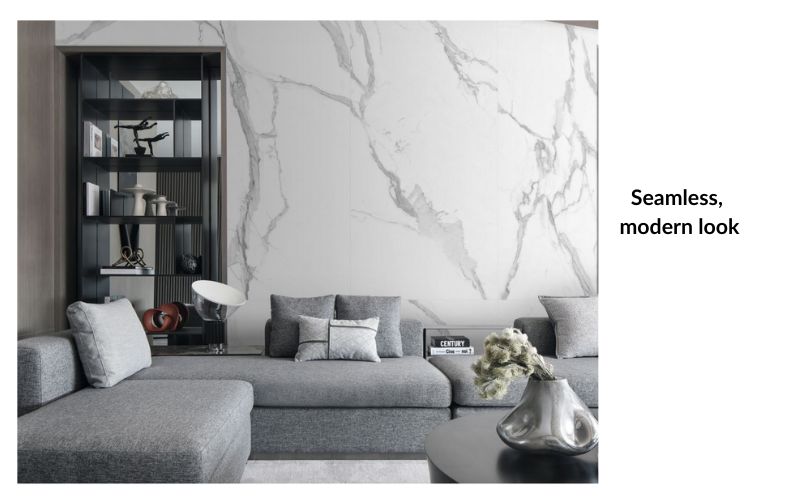
Wall tile applications have different requirements than floors — no load-bearing requirements, but much higher demands on aesthetics, and grout-joint precision. Wall porcelain tiles typically feature:
- Typically 4.5-9mm thickness, For high-rise residential and hospitality projects, weight per square meter matters — heavier tiles increase installation complexity and structural load.
- More decorative finishes and intricate designs.
- Surface finish and calibration: Wall applications magnify any inconsistency in pattern, or dimensional tolerance. Specify rectified tiles for seamless grout joints, particularly for large-format wall installations. Unrectified tiles are acceptable for smaller formats with wider grout joints.
Glazed tile is particularly popular for wall applications, as it allows for virtually unlimited design possibilities. Full-body or color-body porcelain is also an excellent choice for walls, especially in areas where edges might be visible, as the consistent coloration creates a more finished appearance.
Outdoor Tiles
Outdoor porcelain must withstand extreme environmental conditions, including temperature fluctuations, moisture, and UV exposure. Key characteristics include:
- Extremely low water absorption rates ( below 0.5%, better less than 0.1%) to prevent frost damage.
- Frost resistance for cold climates.
- Slip resistance, outdoor wet areas require a minimum of R11. This is non-negotiable in most developed markets.
- Thickness for outdoor pavers: 20mm porcelain pavers have become the standard for patio, and driveways systems in Europe and Australia. They can be laid on pedestals or directly on compacted gravel without adhesive — a major installation advantage for large outdoor projects.
Unglazed full-body porcelain with grip finish is typically the best choice for outdoor applications, particularly in areas that experience freezing temperatures. These tiles maintain their performance characteristics and appearance despite years of exposure to the elements.
Porcelain Tile Types by Surface Finish
When it comes to porcelain tiles, the finish really matters. It affects not just how the tiles look, but also how they perform. The tile finish determines things like texture, shine, and even how slip-resistant they are. So it’s important to choose the right one for your needs.
Typically, we categorize porcelain tiles into the following types based on their surfaces: glazed porcelain tile and unglazed porcelain tile ( including homogeneous tile and polished tile) .
Glazed Porcelain Tile

Glazed porcelain tiles are among the most popular choices for both residential and commercial spaces. These tiles feature a layer of liquid glass on their surface, which is fused to the body of the tile during firing. This layer not only enhances the tile’s aesthetic appeal, providing a glossy or matte finish, but also gives them extra protection against stains and scratches, making them both beautiful and durable.
Glazed porcelain tiles come in various styles, colors, and patterns, making them extremely versatile for any design project.
Advantages:
Wide range of design options: The glaze surface offers a variety of design options, from vibrant colors to intricate patterns, enabling aesthetic flexibility, and you can customize the color and patterns as you want.
Easy to clean and minimal maintenance.
Common Uses:
Residential flooring, bathrooms, moderate commercial floor ( resturant, office & libary) and decorative wall tiles.
Exploring the differences: glazed vs unglazed tile, click and read the post.
Unglazed Porcelain Tile – Homogeneous Tile
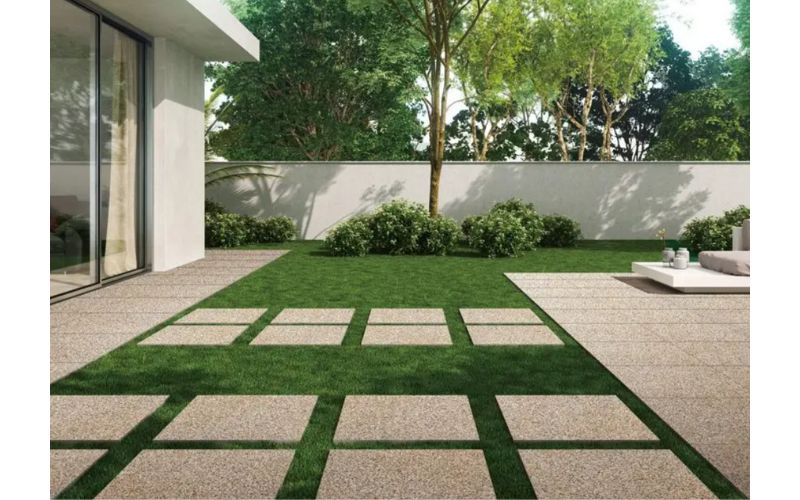
Unglazed porcelain tile is also called homogeneous tile or full-body tile, its surface is without glaze. These tiles are generally more durable and have a consistent color throughout, which is perfect for high-traffic and slip-resistant areas.
Advantages:
Highly durable, and slip-resistant.
Common Uses:
Commercial spaces, outdoor areas, and high-traffic environments.
If you want to know more information about the homogeneous tiles, read our Homogeneous Tiles post.
Unglazed Porcelain Tile – Polished Porcelain Tile
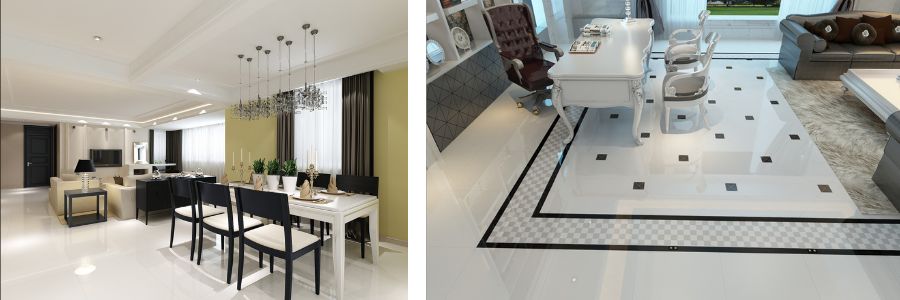
Polished porcelain tiles are famous for their smooth, shiny, mirror-like finish. It remains one of the highest-volume export categories from China.
Why should polished tiles and full-body tiles be discussed separately from unglazed tiles?
The reason is that although polished tiles belong to the category of unglazed tiles, not all polished tiles are full-body. For example, double loading tiles are an exception—they are made by combining a base body with a surface layer, which is then polished.
Advantages:
Elegant appearances and reflective surfaces can make your spaces looks spacious and more luxurious.
Common Uses:
Anywhere the priority is visual impact and brightness. Upscale residential spaces, such as living rooms and commercial interiors.
Unsure the difference between polished tile and the glazed full polished tile? Read Glazed vs. Polished porcelain tiles to get more information.
While glazed and unglazed tiles form the basic classification by surface, they don’t fully describe how a tile actually looks or performs in real use.
In practice, both categories can be finished in different ways — such as full polished, semi-polished, matte, or textured surfaces — each affecting gloss level, slip resistance, and market preference.
In the next section, we’ll break down these common surface finishes and how to choose the right one for your market.
Full Polished Finish

Full polished porcelain tiles are a type of glazed porcelain tile that undergoes an extensive polishing process on the glazing of the tile to achieve an ultra-glossy, reflective surface.
Different from the normal polished porcelain tile, full-polished tile has more designs and patterns, as it can mimic natural stone, like marble, terrazzo, or granite.
Advantages:
Their high-end aesthetic and reflective properties can enhance light in any room. And provide you with a luxury look like marble.
Common Uses:
High-end residential projects, commercial lobbies, and showrooms.
What importers need to know:
Polished finishs are slippery when wet. Most polished porcelain falls in the R9 range, which is acceptable for dry indoor floors but unsuitable for bathrooms, kitchens, or any wet area without anti-slip treatment. Scratch visibility is also higher on polished surfaces — specify hardness (Mohs scale) if your buyers are using these in high-traffic areas.
Semi-Polished Finish
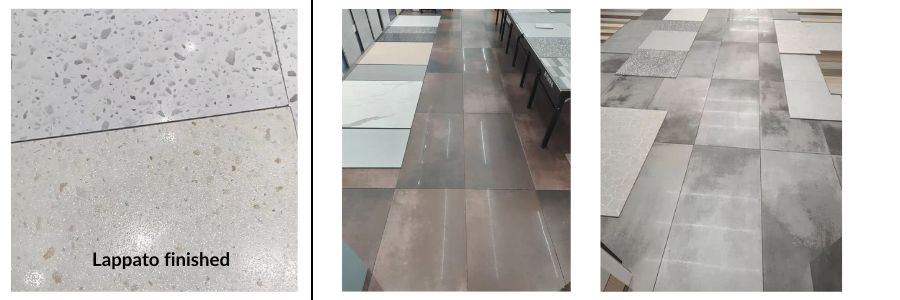
The semi-polished finish is also known as lappato.
The term “Lappato” actually comes from the Italian word for “semi-polished”. The semi-polished tiles are the sweet spot between the shiny finish of fully polished tiles and the subtle look of matte tiles.
During manufacturing, the surface is partially polished to create a subtle sheen that enhances the tile’s natural beauty without the full mirror-like effect of a completely polished tile.
Advantages:
Offer a sophisticated look that reflects light beautifully, adding depth and dimension to any room.
Common Uses:
Buyers who want the elegance of a polished look with slightly better slip resistance. Popular in hospitality and mid-to-high-end residential projects.
What importer need to know:
Slip resistance is typically better than full polish, but still not recommend use for wet rooms without additional anti-slip measures.
Matt Finish
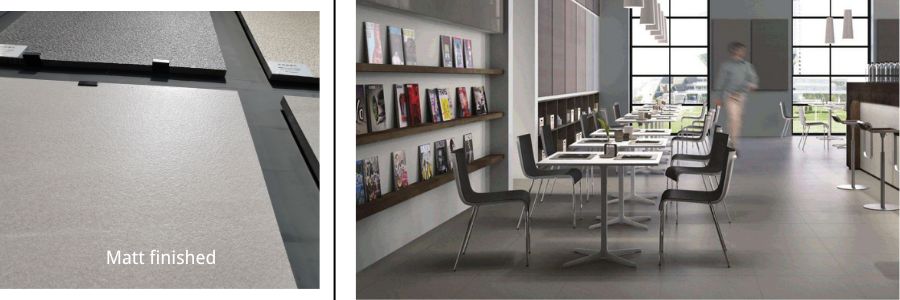
A matt finish porcelain tile is defined by its smooth, non-reflective surface that offers a sleek and understated elegance. Unlike glossy or polished finishes, matt surfaces have a flat appearance that doesn’t reflect light, lending them a contemporary and minimalist aesthetic.
Advantages:
They offer a modern look, suitable for minimalist designs.
Slip-resistance, and are incredibly easy to maintain.
Looks comfortable.
Common Uses:
Floors and walls across residential or commercial projects, and also an excellent choice for areas prone to moisture, such as bathrooms, kitchens, and outdoor patios.
What importers need to know:
Not all matte tiles have the same slip resistance. A smooth matte surface can still be slippery when wet. Always verify the R-rating rather than assuming matte equals safe.
Textured / Structured / Grip Finish
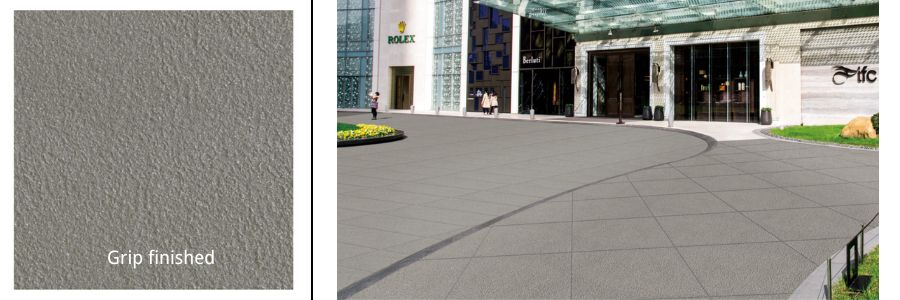
The grip finish on porcelain tiles has a textured surface designed to enhance safety. Unlike smooth finishes, the grip finish incorporates a slightly rough texture that provides additional traction underfoot, significantly reducing the risk of slips and falls. This makes it works particularly well in outdoor and industrial applications.
Advantages:
Good slip-resistant, and highly resistant to moisture and stonas, making them ideal for wet, high-traffic areas, and ease of care.
Common Uses:
Best for outdoor patios, pool surrounds, commercial kitchens, public spaces like spas, and hotels.
What importers need to know:
Texture depth varies significantly between products. A lightly structured tile might achieve R10; a deeply textured stone-effect tile can reach R12 or R13. Meanwhile, also consider cleaning practicality — deeper textures are harder to maintain in food-service environments.
Next, we’ll look at some of the looks and bodies of porcelain tiles to have a complete understanding of this versatile material.
Porcelain Tile Types by Looks
With the advancements in manufacturing technologies, many china’s tile manufacturers invested heavily in digital injet printing technology over the past decade, porcelain tiles types come in various styles that mimic other materials, offering endless design possibilities. It can be classified in wood-look, marble-look, stone look, concrete look, pattern look and solid color based by the tile looks.
Marble-Look Porcelain Tiles
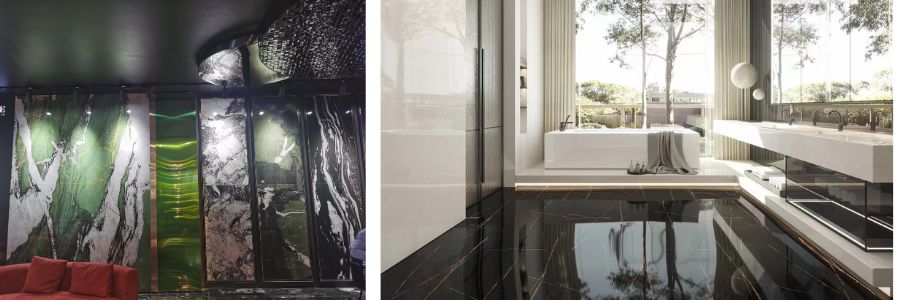
Marble-look porcelain tiles offer the exquisite beauty and veining of natural marble combined with the durability and ease of maintenance that come with porcelain.
Through advanced inkjet printing technology, these tiles capture the intricate patterns and rich color variations of marble, from the delicate whites and greys of Carrara to the deep blacks of Marquina, they create an elegant and sophisticated feeling for any space, whether in bathrooms or commercial lobbies and hallways, at a fraction of the cost and without the upkeep associated with real marble.
Surface finish pairing: Polished and softpolished finishes are the natural match for marble-look tiles. Honed marble-look is gaining traction in the high-end residential market as a more understated alternative.
Want to know how to choose between porcelain tile and the natural marble? Read our post: The battle of tiles: porcelain vs marble.
Stone Look (Slate, Travertine, Sandstone, Quartzite) Porcelain Tiles
Natural stone looks beyond marble cover a wide range of aesthetics — from the rough texture of slate to the warm, pitted surface of travertine. This category has particularly strong demand in outdoor applications, where the natural, earthy aesthetic suits gardens, terraces, and pool areas.
What sells: Travertine-look tiles have seen significant growth driven by the resurgence of warm, Mediterranean-influenced interiors. Slate-look tiles remain strong in outdoor and rustic residential applications. Quartzite and sandstone looks are growing in the premium outdoor segment, particularly in Australia, the Middle East, and Southern Europe.
Concrete-Look Porcelain Tiles
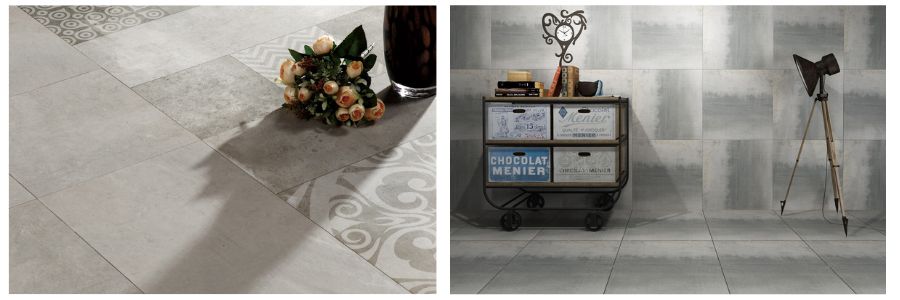
Concrete-look porcelain tiles emerged from the industrial loft aesthetic and have become a mainstream commercial and residential finish globally. They’re among the most versatile tiles in a catalog — neutral, non-directional, and compatible with almost any interior style.
Their strength and resistance to wear make them suitable for high-traffic areas, both residential and commercial, including living rooms, kitchens, and retail spaces. Additionally, the ability of these tiles to resist moisture and stains makes them a practical choice for bathrooms and outdoor living areas.
What sells: Large-format concrete-look tiles (600×600mm, 600×1200mm, 900×900mm) in light to mid grey tones are the commercial workhorse of this category. Warm greige (grey-beige) concrete looks have strong demand in contemporary residential projects. Darker anthracite tones perform well in commercial and hospitality settings.
Wood-Look Porcelain Tiles

Wood-look porcelain has taken significant market share from real hardwood and laminate flooring in residential and commercial interiors over the past decade — particularly in markets where humidity, underfloor heating, or heavy use makes real wood impractical.
It provides a practical solution for achieving a timeless and elegant look, offering the beauty of wood floors without the upkeep, and without the susceptibility to water damage, scratches, or wear that comes with natural wood.
They are perfect for spaces like bedrooms, kitchens, balconies, and living rooms where you want the charm of wood but need the durability of porcelain. Their resistance to moisture and stains also makes them suitable for outdoor spaces.
What sells: Plank formats (200×1200mm, 200×1000mm, 150×900mm) with realistic wood grain texture and color variation are the core of this category. Warm oak tones remain globally dominant. Grey and whitewashed wood looks have strong demand in Scandinavian-influenced markets. Dark walnut and exotic wood looks perform well in the luxury hospitality segment.
To know the advantage and disadvantage of the porcelain wooden tile, read our previous post: porcelain wood tile pros and cons.
And if you want to compare the ceramic wooden tile and wooden floors, read our post to get more information: tile vs wood flooring.
Patterned-Look Porcelain Tiles

Patterned look porcelain tiles stand as an eye-catching choice for those aiming to infuse their spaces with vibrancy and uniqueness. These tiles come adorned with a myriad of designs, ranging from intricate geometric patterns to delicate floral motifs, offering an artistic element that can transform any room into a visual masterpiece.
This versatility makes them especially suitable for feature walls, backsplashes, and accent floors. Beyond their aesthetic appeal, patterned-looking porcelain tiles retain all the practical benefits of traditional porcelain, including durability, low maintenance, and moisture resistance, making them ideal for both residential and commercial applications.
Want to exploring more details of pattern tile? Here’s a quick comparison to help you understand: what is encaustic Tile? cement and porcelain differences.
Plain / Solid Color Porcelain Tiles
Not every project needs a pattern. Solid-color porcelain tiles are a staple of commercial, healthcare, and minimalist residential design — and a high-volume export category that’s easy to overlook in favor of more decorative options.
What sells: Large-format solid tiles in white, Ivory and light grey are the foundation of any general tile catalog. Saturated color tiles — deep navy, forest green, terracotta — have strong demand in the design-led residential and boutique hospitality segment, driven by maximalist interior trends.
Porcelain Tile Types by Tile Body Composition
The composition of porcelain tiles plays a crucial role in determining their suitability for various applications. Different types of porcelain tile bodies offer distinct benefits and performance characteristics. So based on the composition, the porcelain tile types can be categoried: off-white body, full-body, color-body, and double-layers.
Off-white Body
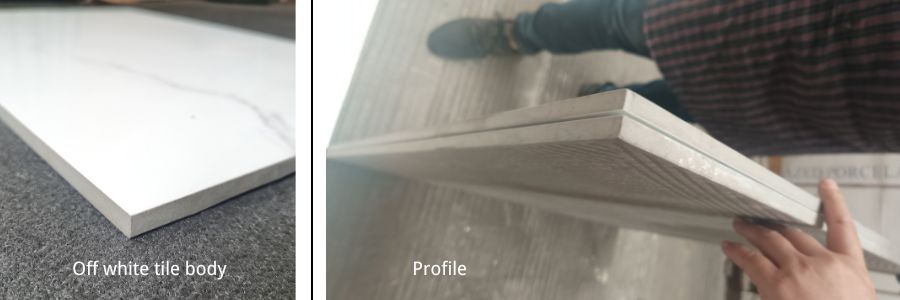
Off-white porcelain tile is often a glazed tile with an off-white tile body and designs printed on the tile surface glazing. Unlike red-body tiles, off-white porcelain tiles don’t turn red because the material contains very few metal oxides such as iron oxide. Besides, off white body can make a light color pattern design of the surface look whiter and softer.
Advantages:
They are durable, have various designs, and are cost-effective.
Common Uses:
Perfect for residential floors and walls, commercial spaces, and minimalist designs.
Full Body

Full-body porcelain tiles have uniform color, texture, and material throughout the tile.
Advantages:
They are highly durable, scratch-resistant, and suitable for heavy-duty applications.
Common Uses:
Ideal for shopping malls, public floors, industrial spaces, and outdoor floors.
Color Body
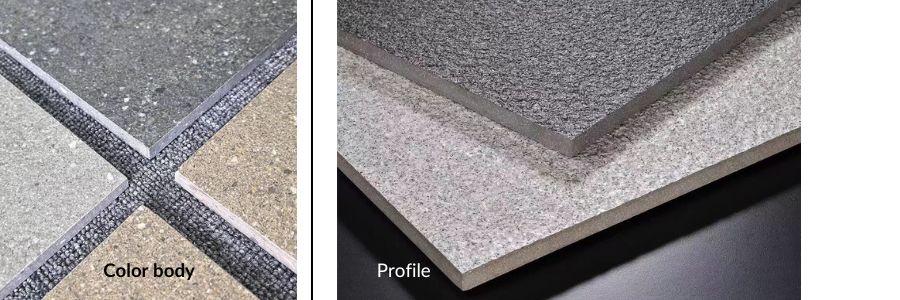
Color body porcelain tiles have a body color that is identical to the surface. This continuity of color reduces the visibility of chips or wear over time, making the tile color look consistent when grooved or cut.
Advantages:
They offer color consistency and pattern integrity. Different from full-body tiles, color body tiles focus on matching the surface and tile body colors to ensure that they look similar, without requiring the material composition to be uniform throughout, so they can have more color and pattern designs. In the meantime, the price is usually lower than a full-body tile.
Common Uses:
Excellent for both residential and commercial projects, such as high-traffic areas like hotels, restaurants, and office lobbies.
Double-Layer Body
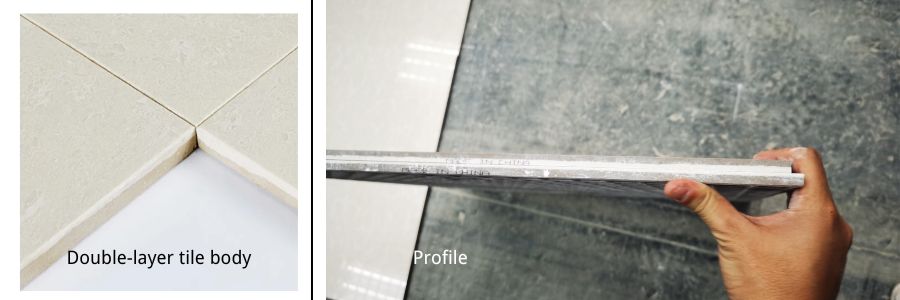
Double-layer porcelain tiles, also known as double-loaded or double-charge polished tiles, are a type of tile that features two layers of porcelain pressed together during the manufacturing process.
The top layer, typically about 3 to 4 millimeters thick, is composed of high-quality, highly durable colored porcelain that provides the surface pattern and design. The bottom layer consists of a less expensive base material that offers structural support and additional thickness.
Advantages:
They provide enhanced durability, thicker construction, and superior wear resistance, and they are also cost-effective.
Common Uses:
Suitable for residential and commercial flooring, especially in heavy-traffic areas like airports, kitchens, hallways, and office lobbies.
Knowing your product types is one thing — knowing which Chinese factories produce them well, and at what price point, is another. For the full sourcing overview, see our in-depth guide to importing tiles from China.
How to Choose: Matching Tile Type to Project
Every sourcing decision comes down to the same question: which tile is right for this specific project? The four classification dimensions covered in this guide — application, surface finish, visual style, and tile body — don’t operate independently. The right tile is always a combination of all four, matched to the project’s functional and technical specs requirements (water absorption, slip resistance, hardness, and wear rating), aesthetic direction, and budget fit into the equation.
Get these right, and you’re not just choosing a tile — you’re choosing something that will durable, looks great, and save you from costly replacements a few years in.
Determine the Application Environment
The first step is to identify where and how the tile will be used:
| Environment | Primary Concerns | Recommended PorcelainTile Types |
| Residential Indoor Floors | Durability, cleaning ease, comfort | Glazed porcelain Tile (PEI 3-4) Polished Porcelain Tile |
| Commercial Floors | High traffic resistance, safety | Full-body unglazed or color-body (PEI 4-5) |
| Bathroom Walls & Floors | Water resistance, cleaning ease | Glazed porcelain with water-resistant finish |
| Outdoor Floors | Weather resistance, slip safety | Textured homogeneous porcelain tile with grip finish |
| Hotel Lobby | Durability, luxury, cleaning ease | Glazed full polished porcelain with marble look |
| Shopping Mall Floors | Durability, wear resistance, cleaning ease | Polished porcelain tile ( full body or double layer) |
Consider Technical Requirements
Match the tile’s technical specifications to the installation requirements:
Water Absorption Rate:
Water absorption is the single most important technical specification for porcelain tile. It determines whether a tile can legally and practically be used in a given application — and it’s the primary distinction between porcelain and ceramic under international standards.
- Areas exposed to water or moisture: Choose tiles with <0.1% absorption
- Standard indoor areas: Tiles with ≤0.5% absorption are sufficient
- Outdoor areas in freeze-thaw climates: Must use tiles with <0.1% absorption
If you’re still weighing up whether porcelain or ceramic is the right fit for your market, our guide to ceramic vs porcelain tiles breaks down the key technical differences and helps you decide which product suits which application
Slip Resistance (R Rating):
Slip resistance is the specification most likely to create legal liability for importers in developed markets. In Germany, the UK, Australia, and America, slip resistance requirements for specific applications are defined in building regulations — and non-compliance can result in project rejection or litigation following an accident.
The R rating system: Developed in Germany (DIN 51130) and now widely adopted internationally, the R scale runs from R9 to R13:
| R Rating | Slip Resistance Level | Typical Application |
|---|---|---|
| R9 | Low | Dry residential interiors |
| R10 | Medium | Residential bathrooms, light commercial |
| R11 | High | Commercial kitchens, outdoor areas, ramps |
| R12 | Very high | Industrial areas, outdoor stairs |
| R13 | Extreme | Industrial ramps, heavy outdoor use |
PEI Rating (Durability):
The PEI (Porcelain Enamel Institute) rating measures a glazed tile’s resistance to surface abrasion — essentially, how well the glaze holds up under foot traffic over time. It applies specifically to glazed tiles; full-body and double-charge tiles don’t use this rating system.
| PEI Rating | Recommended Use |
|---|---|
| PEI I | Wall tiles only — no floor use |
| PEI II | Residential floors with light traffic (bare feet, soft footwear) |
| PEI III | Residential and light commercial floors |
| PEI IV | Moderate to heavy commercial floors |
| PEI V | Heavy commercial and industrial floors |
What project buyers need to know: PEI III is the minimum acceptable rating for general residential floor use. Specifying PEI II tiles for a floor application — even in low-traffic areas — creates a quality risk that will come back to you when the glaze shows wear within a few years. For commercial projects, default to PEI IV unless you have a specific reason to go lower.
Surface Hardness (Mohs Scale)
The Mohs hardness scale measures a tile’s resistance to surface scratching — relevant primarily for polished and softpolished tiles in residential and commercial applications.
The scale in practice: Porcelain tile typically rates between 6 and 8 on the Mohs scale. A rating of 6 or above means the tile surface resists scratching from most everyday materials — keys, sand tracked in on shoes, cleaning equipment.
When to specify this: For polished residential floor tiles and any glazed tile going into a kitchen or high-use living area, specify a minimum Mohs hardness of 6. For heavy commercial polished floors, 7 or above is preferable. This spec is less critical for matte and textured tiles, where minor surface scratching is less visible.
Evaluate Aesthetic Considerations
The visual impact of the tile is equally important for market appeal:
Design Authenticity:
- For natural stone looks: Digital printing technology allows for dozens of unique patterns in porcelain that mimic marble, granite, or travertine
- For wood looks: Consider longer plank formats with textured surfaces that replicate wood grain
Surface Finish Impact:
- Polished finishes: Create reflective, elegant surfaces but may be more slippery when have water
- Matte finishes: Provide better traction and hide dirt more effectively
- Textured finishes: Offer excellent slip resistance but may collect dirt in the texture if no enough cleaning
Budget and Value Considerations
Different porcelain tile types vary significantly in price:
Value-Focused Options:
- Standard glazed porcelain offers good durability at moderate price points
- Soluble salt porcelain and parts of doule layer polished porcelain usually provides basic functionality at entry-level prices
Premium Options:
- Double-loaded porcelain offers excellent wear characteristics for high-traffic areas
- Full-body through-color porcelain provides superior durability and ageless appearance
- Digital printed porcelain with natural stone looks offers luxury aesthetics at a fraction of natural stone prices
When evaluating cost, consider the total lifecycle cost rather than just the initial purchase price. Higher-quality porcelain may cost more initially but often lasts longer and requires less maintenance, providing better long-term value.
Conclusion
Porcelain tiles come in a wide variety of designs and functionalities. Whether it’s the luxury of marble-like tiles or the industrial style of concrete-look tiles, each has its own distinct look. They excel in durability, ease of maintenance, and resistance to wear and moisture.
Understanding the different types of porcelain tile bodies—off-white, full body, color body, and double layer—can help you make an informed selection based on your requirements. Full body and double-layer porcelain tile: have good wear resistance, suitable for heavy traffic areas. Off-white body tile, lower cost, and has many design options. Whereas color body tile, is suitable for cutting and grooved edges but lower cost than full body tile.
Regardless of your choice, porcelain tiles remain an affordable and reliable alternative for both residential and commercial projects.
Frequently Asked Questions For Porcelain Tile Types
Q 1: What is the main difference between porcelain and ceramic tiles?
A: Porcelain tiles are made from more refined clay and fired at higher temperatures (1,200-1,400°C) than ceramic tiles, resulting in a denser, less porous product with water absorption of 0.5% or less. Ceramic tiles typically have water absorption rates above 0.5% and are less dense, so they are not strong as porcelain tile, and the anti-stain is not as good as porcelain tile.
Q 2: Are porcelain tiles suitable for outdoor use?
A: Yes, unglazed full-body porcelain tiles with low water absorption rates (<0.1%) are excellent for outdoor use, as they resist freezing, thawing, and UV fading. Look for tiles specifically rated for outdoor applications.
Q 3: Can porcelain tiles be used on walls?
A: Absolutely. While porcelain is heavier than ceramic, thinner porcelain tiles (4.5-8mm) are perfectly suitable for wall applications and offer superior durability and moisture resistance compared to ceramic.
Q 4: What does PEI rating mean for porcelain tiles?
A: PEI (Porcelain Enamel Institute) ratings indicate a tile’s durability and resistance to surface wear on a scale from 1-5. PEI 1 is suitable only for walls, while PEI 5 can withstand heavy commercial traffic.
Q 5: What is the difference between glazed and unglazed porcelain?
A: Glazed porcelain has a layer of liquid glass applied to its surface before final firing, creating a protective layer that can incorporate colors and patterns. Unglazed porcelain has no additional surface layer, with color and texture consistent throughout the tile.
Q 6: What does “rectified” mean in porcelain tiles?
A: Rectified tiles have had their edges precisely cut after firing to ensure extremely consistent dimensions. This allows for narrower grout lines (as small as 2mm) and a more seamless appearance in the finished installation.
Q 7: Do different types of porcelain tile require different installation methods?
A: Yes. Large-format tiles require more precise substrate preparation and often need special mortars. Full-body unglazed porcelain may need different sealers than glazed porcelain. Always follow manufacturer recommendations for specific tile types.
Related Post: