
Picture this: your shipment arrives on site, the project manager opens a box, and something feels off. The tiles match the photos, the price was right, but the specification said porcelain — and what’s sitting in front of you behaves like ceramic. No test report. No way to prove compliance. And a building inspector arriving on Monday.
These are issues that some project contractors have encountered — or narrowly avoided — in the past. And it’s almost always avoidable.
Here’s the thing — choosing between ceramic and porcelain isn’t really about which one is “better.” It’s about matching the right material to the right project. The application, the budget, the technical requirements of the project, and the compliance standards of the destination market together tell you what you need. Get that match right upfront, and everything downstream gets easier.
That’s what this guide is for.
What Are Ceramic and Porcelain Tiles?
At their core, both ceramic and porcelain tiles are made from clay fired in a kiln. But the differences in raw materials and firing temperature produce two products with meaningfully different physical properties — and that’s what determines where each one can and can’t be used.
Ceramic tile is made from a coarser natural clay body, fired at around 900-1,100°C. The result is a lighter, less dense tile that works well for interior wall applications and low-traffic floors. It’s easier to cut, lighter in weight, and generally less expensive to produce.

Porcelain tile uses a more refined clay mixture — typically including feldspar and fine-grained silica — fired at over 1,200°C. The higher temperature produces a denser, harder tile with a water absorption rate of 0.5% or less. That single number — 0.5% — is what the international standard ISO 13006 uses to define porcelain, and it’s what makes porcelain suitable for floors, wet areas, and commercial spaces where ceramic isn’t.
Quick comparison:
| Ceramic | Porcelain | |
|---|---|---|
| Durability | Moderate | High |
| Strength | less strength, easy to scratches | superior strength and hardness, not easy to crack |
| Installation | Easier, lighter, and easy cut | Requires more care for large formats |
| Cost | Lower | Higher |
| Best for | Interior walls, low-traffic floors | Floors, wet areas, commercial spaces |
For a deeper look at porcelain tile properties and performance, see our Porcelain Tile Pros and Cons guide and Types of Porcelain Tiles.

What’s the Key Difference Between Porcelain And Ceramic Tile?
Here is the key differences at a Glance:
| Dimension | Ceramic | Porcelain |
|---|---|---|
| Water absorption | >0.5% (typically 3–7%, and above 10% for walls) | ≤0.5% |
| Firing temperature | ~1,100°C | 1,200°C+ |
| Density / hardness | Lower | Higher |
| PEI wear rating (for glazed tile) | PEI I–III | PEI I–V |
| Primary application | Interior walls | Floors, wet areas, commercial spaces |
| Outdoor / frost use | Not suitable | Suitable (verify certification) |
| International standard | ISO 13006 Group BIII | ISO 13006 Group BIa |
| Relative export price | Lower | Higher |
The single most important number in this table is water absorption. Every other performance difference between ceramic and porcelain — frost resistance, load-bearing capacity, chemical resistance, suitability for outdoor use — flows directly from that one measurement. It’s also the number that international standards use to draw the line between the two materials. If a supplier can’t provide a third-party water absorption test report, treat the product classification as unverified.
Why It Matters for Importers
Most articles about ceramic vs porcelain are written for homeowners choosing a bathroom tile. For importers supplying construction and fit-out projects, the stakes are different — and the consequences of getting it wrong are measured in project delays, compliance failures, regulatory penalties, and client relationships, not just aesthetics.
Engineering compliance risk
Hotels, hospitals, schools, and commercial developments are built to specifications. Those specifications typically define minimum technical requirements for floor tiles — water absorption thresholds, slip resistance ratings, wear resistance classifications. These requirements exist for safety and durability reasons, and they’re enforced.
A ceramic tile installed where porcelain was specified isn’t just a quality compromise. In many cases it’s a compliance failure — one that can mean mandatory replacement before handover, or liability exposure if a slip or structural issue occurs post-installation.
In markets with enforced building standards like the EU, GCC countries, and Australia, this isn’t a theoretical risk. It’s a documented cause of project disputes.
Customs classification and HS codes
Ceramic and porcelain tiles are classified under different HS codes in several major import markets. The distinction affects applicable import duties, documentation requirements, and in some cases, eligibility for preferential trade terms.
Importing a product declared as porcelain that technically classifies as ceramic — even if the difference wasn’t intentional — creates customs liability for the importer, not the manufacturer. Confirming the correct classification before shipment is a basic risk management step that’s easy to overlook when you’re focused on price and lead time.
Passing off ceramic tiles as porcelain tiles
It’s a known practice in parts of the Chinese tile market to label ceramic products as porcelain, particularly when the price gap makes substitution financially attractive for the supplier.
Meanwhile, some unprofessional factory or salesperson may sell ceramic tiles as porcelain tiles, because they believe any tile with water absorption below 3% qualifies as porcelain. This is incorrect. True porcelain tile typically has a water absorption rate of less than 0.5%, according to international standards.
Because of this, for importers and project buyers, a product label or a supplier’s verbal assurance isn’t enough.
The visual difference between a glazed ceramic tile and a glazed porcelain tile of similar design is often undetectable without testing. The verification steps in this guide exist precisely for this reason.

Choosing between ceramic and porcelain is just the starting point — if you’re sourcing from China, understanding production regions, pricing structure, and supplier selection matters just as much. Our complete guide to buying tiles from China covers the full picture.
Ceramic and Porcelain Performance Comparison in Different Project Types
The performance difference between ceramic and porcelain tile isn’t abstract —it shows up in specific, practical ways depending on where the tile is installed. Here’s how the two materials compare across the project types we work with most.
Residential projects
Floor tiles: Porcelain is the standard choice for residential floors across all rooms. Glazed porcelain covers most residential floor applications comfortably — specify PEI III as a minimum for living areas, PEI III–IV for kitchens. The density and wear resistance of porcelain simply outlasts ceramic in floor applications.

Wall tiles: This is where ceramic genuinely competes. For interior bathroom and kitchen walls in residential projects, glazed ceramic tiles are a legitimate, cost-effective choice. The higher water absorption rate that disqualifies ceramic from floor and outdoor use is actually advantageous for interiors wall installations — it improves adhesion to wall substrates and reduces the risk of tile debonding over time. Ceramic wall tiles are lighter than porcelain, which matters in high-rise residential construction where floor load is a consideration.
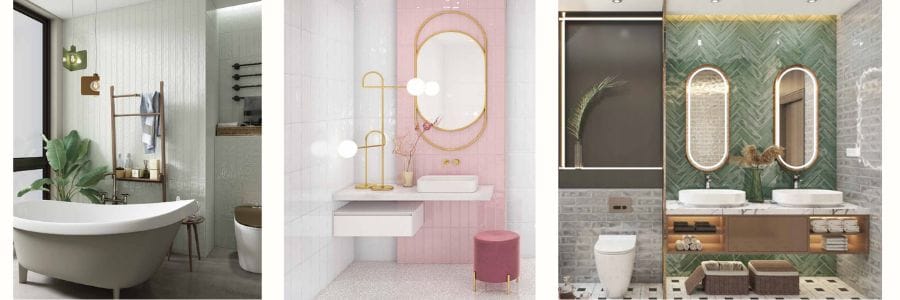
If want to know more details of subway tiles, read our subway tile 101 guides, you will have full pictures from types, size, edge option, to the quality control.
Commercial projects (restaurants, libraries, and similar spaces)
Not every commercial project runs at supermarket intensity. Restaurants, libraries, cafés, and similar spaces have their own specific requirements — typically centered on aesthetics, ease of maintenance, and moderate durability rather than extreme load-bearing performance.
Restaurants: Floor tile for dining areas needs to balance visual appeal with practical slip resistance — R10 is the appropriate minimum for front-of-house areas. Glazed porcelain or homogeneous tile in 600×600mm or 600×1200mm formats works well in dining rooms where the priority is a clean, attractive finish that holds up to regular mopping and moderate foot traffic. For kitchen floors, the specification shifts significantly: R11–R12 slip resistance, full-body porcelain, and a format small enough to maintain adequate grout coverage for grip.
Libraries, museum and similar low-to-moderate traffic spaces: These environments are considerably less demanding than hospitality or retail. Polished porcelain or glazed porcelain tile at PEI III–IV or Mohs Scale above 7 is sufficient for most library floor applications. Large-format tiles — 600×600mm or 800×800mm — are common in these spaces, where the visual priority is a calm, consistent floor finish that doesn’t compete with the environment. Matte or polished finishes are the standard choice: practical for maintenance and appropriate for the quieter aesthetic these spaces typically call for. Wall tiles in these settings are often decorative rather than functional, and glazed porcelain or ceramic both work well depending on the design brief and budget.

Hotel projects
Hotels are where specification precision matters most. A single fit-out project can involve tens of thousands of square meters of tile across multiple product lines — and batch consistency across that volume is as important as the tile specification itself.
Lobby and corridor floors:
full-body porcelain is the appropriate choice. Surface Hardness Mohs Scale 7 is minimum. These areas take constant traffic from luggage, trolleys, and cleaning equipment. Specify rectified tiles for tight grout joints and a seamless large-format finish.
Guest room floors:
Glazed porcelain at PEI III–IV. Large format tiles (600×600mm, 600×1200mm) are increasingly standard in mid-to-high-end hotel rooms. Confirm that your supplier can maintain color and dimensional consistency across the full project volume — batch-to-batch variation is the most common quality complaint on hotel projects (especially for the solid color style), and it’s almost impossible to resolve after installation.
Bathroom walls:
Glazed porcelain is is the better choice over ceramic for hotel bathrooms. Ceramic is technically suitable for wall use but porcelain’s lower absorption rate and surface durability provides a better long-term outcome in a space that’s cleaned with commercial chemicals multiple times daily.
Hospital projects
Hospitals have more demanding tile specifications than almost any other project type — and less tolerance for compromise. The relevant performance requirements go beyond durability.
Floors: Full-body porcelain is the only appropriate choice. R10 minimum slip resistance for general corridor and ward floors; R11 for wet clinical areas. Many hospital projects — particularly those meeting international health facility standards or targeting accreditation — specify anti-bacterial surface treatment. Request ISO 27447 test reports if this is a project requirement. Ceramic is not suitable for hospital floors under any circumstances.
Supermarket projects
Supermarkets are one of the most demanding floor tile environments in commercial construction — not just because of foot traffic, but because of what else shares the floor: heavy shelving systems, loaded pallet jacks, forklifts, and trolleys that never stop moving. The tile specification needs to reflect that reality.
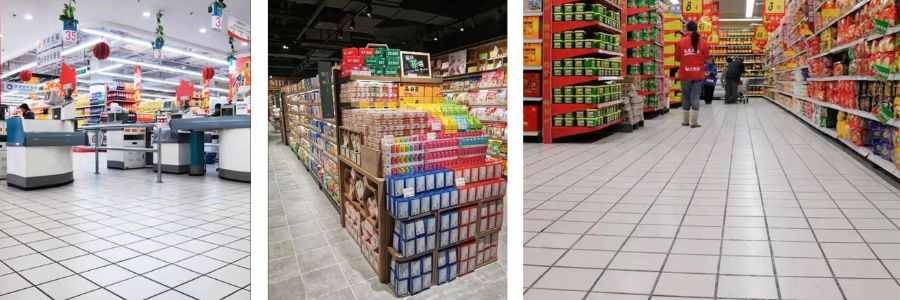
For the main sales floor and warehouse areas, full-body porcelain is the baseline requirement. But beyond material type, two specifications matter more here than in almost any other project type:
Thickness: Standard porcelain floor tiles at 9–11mm are not adequate for areas with heavy racking systems or forklift traffic. For these environments, specify tiles at approximately 12-15mm thickness. The additional thickness significantly improves load-bearing capacity and reduces the risk of cracking under concentrated point loads — a problem that shows up quickly with standard-thickness tiles in a busy supermarket.
Format and slip resistance: Counterintuitively, smaller formats perform better in heavy-use supermarket environments than large-format tiles. 150×150mm, 200×200mm and 300x300mm tiles are common specifications for supermarket floors precisely because the increased number of grout joints adds meaningful slip resistance — wider grout lines with appropriate jointing compound provide grip that a large-format tile with minimal grout coverage simply can’t match. This is especially important in areas where spills are frequent, such as fresh produce, meat, and refrigerated goods sections.
Comparison Table By project types
| Project type | Recommended floor tile | Recommended wall tile | Key specification |
|---|---|---|---|
| Residential living area | Glazed Porcelain | — | PEI III, ≤0.5% absorption |
| Residential bathroom (floor) | Glazed Porcelain | — | R10, ≤0.5% absorption |
| Residential bathroom (wall) | — | Glazed Ceramic / Porcelain | rectified or non-rectified |
| Hotel lobby / corridor | Full-body Porcelain | Glazed Porcelain | Surface Hardness Mohs Scale≥7, batch consistency |
| Hotel guest room floors | Glazed Porcelain | — | PEI III–IV, ≤0.5% water absorption |
| Hotel bathroom | Glazed Porcelain | Glazed Porcelain | R10, chemical resistance |
| Commercial spaces | Glazed porcelain or homogeneous tile | Glazed Ceramic / Porcelain | Floors: PEI III–IV or Mohs Scale ≥ 7, Anti slip ≥ R11 for kitchen floors. |
| Hospital | Full-body Porcelain | — | general areas: R10+, wet clinical areas: R11+, anti-bacterial surface treatment |
| Supermarket | Full-body Porcelain | Glazed Porcelain | 12-15mm thickness, small size: 200*200mm, or 150*150mm, anti slip. |
Cost Analysis: What Drives the Price Gap?
The price difference between ceramic and porcelain is real — but it’s not uniform, and understanding what’s behind it helps you make sharper sourcing decisions and have more credible conversations with both suppliers and clients. The price gap mainly because these factors: raw material & production cost, specification & surface treatment, production regions, and Certification costs. Let’s discuss one by one.
Raw material & production cost
The cost difference starts with materials and energy. Porcelain requires more refined clay inputs and significantly more energy to fire. This isn’t about margin — it’s manufacturing cost reality.
Specification, surface treatment and edges
Within porcelain alone, specification choices drive more price variation than the ceramic-to-porcelain gap itself. A standard 600×600mm matte glazed porcelain and a 1200×600mm softpolished glazed porcelain tile can differ by a factor of two or three — same material category, very different production complexity.
For project sourcing, the discipline is specifying exactly what the project requires: don’t default to a premium finish where a standard one will do, and don’t cut corners where the application genuinely demands more.

Another factor that affects tile price is the edge finish. Rectified tiles go through an extra mechanical cutting process after firing, which adds to the production cost and makes them generally more expensive than non-rectified tiles. If budget is a consideration for your project, it is worth understanding how this difference affects both price and installation. Read our guide on rectified vs non-rectified tiles to learn more.
Production origin
China’s tile manufacturing isn’t uniform. Foshan in Guangdong remains the country’s dominant export hub, with factories ranging from highly automated operations with mature quality systems to smaller workshops primarily serving the cutting requirement, it’s one-stops severice which can not find than any regions in china.
Other regions — Zibo in Shandong, parts of Jiangxi and Fujian — offer different price points that reflect real differences in equipment, quality management, and export capability.
For project sourcing, origin matters not as a quality label but as a proxy for a factory’s ability to maintain consistency across large orders, respond to quality issues, and meet international certification requirements. For a large scale project, those capabilities matter more than the unit price. And if you have cooperate with diffferent supplier from these regions, you will know their service and professional standard is also different.
MOQ and project volume pricing
The gap between sample order pricing and full project order pricing from the same factory can be 5–15% on unit price. For project sourcing, locking in batch pricing and lead time early — ideally before the project tender is finalized — protects both your margin and your supply security.
For projects with multiple delivery shipments, build batch consistency terms into the contract from the start: acceptable color variation (△E value), independent test reports per production batch if nessary, and a clear process for addressing non-conforming material before it ships — not after it arrives on site.
Hidden costs that show up at project completion
Unit price is what everyone negotiates. These are the costs that quietly erode margin:
Transit damage: Thin formats, large slabs, and long plank tiles break at higher rates in container shipping than standard 600×600mm tiles.
Installation wastage: Large-format tiles have higher cutting wastage than standard square formats. Factor 10–15% wastage into your quantity calculations for formats above 800×800mm. Running short on a project tile mid-installation is a genuinely painful problem to solve.

Batch replacement: If a quality issue surfaces after installation begins, sourcing replacement tiles from the same production batch becomes critical — and often impossible if the batch has sold out. Holding a calculated reserve from the original production run is almost always cheaper than the alternative.
Market Fit: Matching the Right Tile to Your Project and Market
Every experienced project buyer eventually arrives at the same understanding: the question isn’t which tile is better. It’s which tile fits this project, in this market, for this client.
Getting the tile specification right is only half the job. The destination market determines what documentation you need, what technical standards apply, and in some cases, what the mandatory minimums are regardless of what the project spec says.
- European Union: EN 14411 is the governing standard. CE marking is required for construction products. Floor tile slip resistance requirements are defined at the national level within the EU framework — Germany’s DIN 51130 (R-rating) is the most widely referenced, but verify the specific requirements for your destination country.
- GCC / Middle East: SASO certification is mandatory for Saudi Arabia. Other GCC markets follow GSO standards with varying enforcement levels. Porcelain is effectively the default specification for any commercial floor application in this market.
- Southeast Asia: Building code standards vary significantly by country and are less uniformly enforced than in Europe or Australia. However, major developers, international hotel operators, and hospital groups operating in the region consistently specify to international standards.
- Australia and New Zealand: AS/NZS 4586 is the mandatory slip resistance standard — it uses a different test methodology from the European DIN 51130 R-rating system, and the two are not directly interchangeable. A tile certified R10 in Europe is not automatically compliant with the Australian standard. For any floor tile destined for Australia, request AS/NZS 4586 test reports specifically.
How to Verify the Tile You’re Actually Buying
Specification documents and supplier assurances establish what you’ve agreed to. These steps establish what you’re actually receiving.
- Request third-party laboratory test reports before you order. The water absorption test (ISO 13006 / ASTM C373), dimensional and warpage tolerance, must be conducted by an accredited independent laboratory — not a factory quality control department. The report should show the measured absorption percentage or data for the specific product, not just a pass/fail confirmation. A report that says “conforms to ISO 13006 Group BIa” without showing the actual measurement is not adequate documentation.
- Check the tile body. Turn a tile over and look at the clay body on the back. Porcelain clay bodies are typically white to light grey. Ceramic clay bodies are often noticeably more red or brown due to the coarser, iron-rich clay composition. This isn’t a definitive test — but a clearly red or brown body on a product marketed as porcelain is a signal worth investigating.
- Require batch-specific test reports for large orders, especially if your cooperating project is a multinational company. A single product test report covers one production run. Build this requirement into your purchase contract before the order is placed — retrofitting it after production has started is difficult.
- Conduct factory audits for new suppliers. For project volumes above a certain threshold, a factory audit is worth the cost. Focus on production equipment age and maintenance, quality management system certification (ISO 9001), in-line quality control processes, and the project what the suppliers have supplied to. A supplier who can show you several completed hotel projects in your region is demonstrably lower risk than one who can’t.
Conclusion
Ceramic and porcelain tile are not interchangeable — not technically, not commercially, and not from a compliance standpoint. For importers supplying construction and fit-out projects, the distinction matters at every stage: specification, sourcing, documentation, and delivery.
The framework is straightforward. Porcelain is the default for floors, wet areas, commercial spaces, and any application where durability, compliance, or long-term performance is a requirement. Ceramic is a legitimate, cost-effective choice for interior wall applications where its properties are appropriate and its lower cost is a genuine advantage. The project type, the destination market’s standards, and the client’s specification together define which material is right.
If you’re sourcing tiles for an upcoming project and want to confirm the right specification for your application, contact our team for a consultation. We work with importers across residential, hotels, education, and commercial sectors, and can provide samples, test documentation, and project references for your refence.
FAQ‘s for Ceramics and Porcelain
1. How can I verify if a tile is truly porcelain?
Check the water absorption rate (should be ≤0.5%) and always request a third-party test report—don’t rely only on supplier claims.
2. Does porcelain tile always require different HS codes than ceramic?
Not universally — classification varies by country. In many import markets, ceramic and porcelain fall under different subheadings with different duty rates. Confirm the correct classification with a customs broker in your destination market before the first shipment. Misclassification creates liability for the importer regardless of how the exporter declared the product.
3. Why are some “porcelain tiles” much cheaper than others?
They may not be true porcelain. Some suppliers mislabel ceramic tiles as porcelain, especially when prices are unusually low. Or the tiles from diferent production region, the raw material and labour cost can be vary.
4. Can ceramic tiles be used for floors?
Yes, but mainly for light residential use. For heavy traffic or commercial areas, porcelain is a safer choice.
5. Is porcelain tile always better than ceramic tile?
Not necessarily. Porcelain is more durable and premium, but ceramic is often better for price-sensitive markets and high-volume sales. For project sourcing, the discipline is clear what the project requires, don’t default to procelain where ceramics will do.
Related posts: